

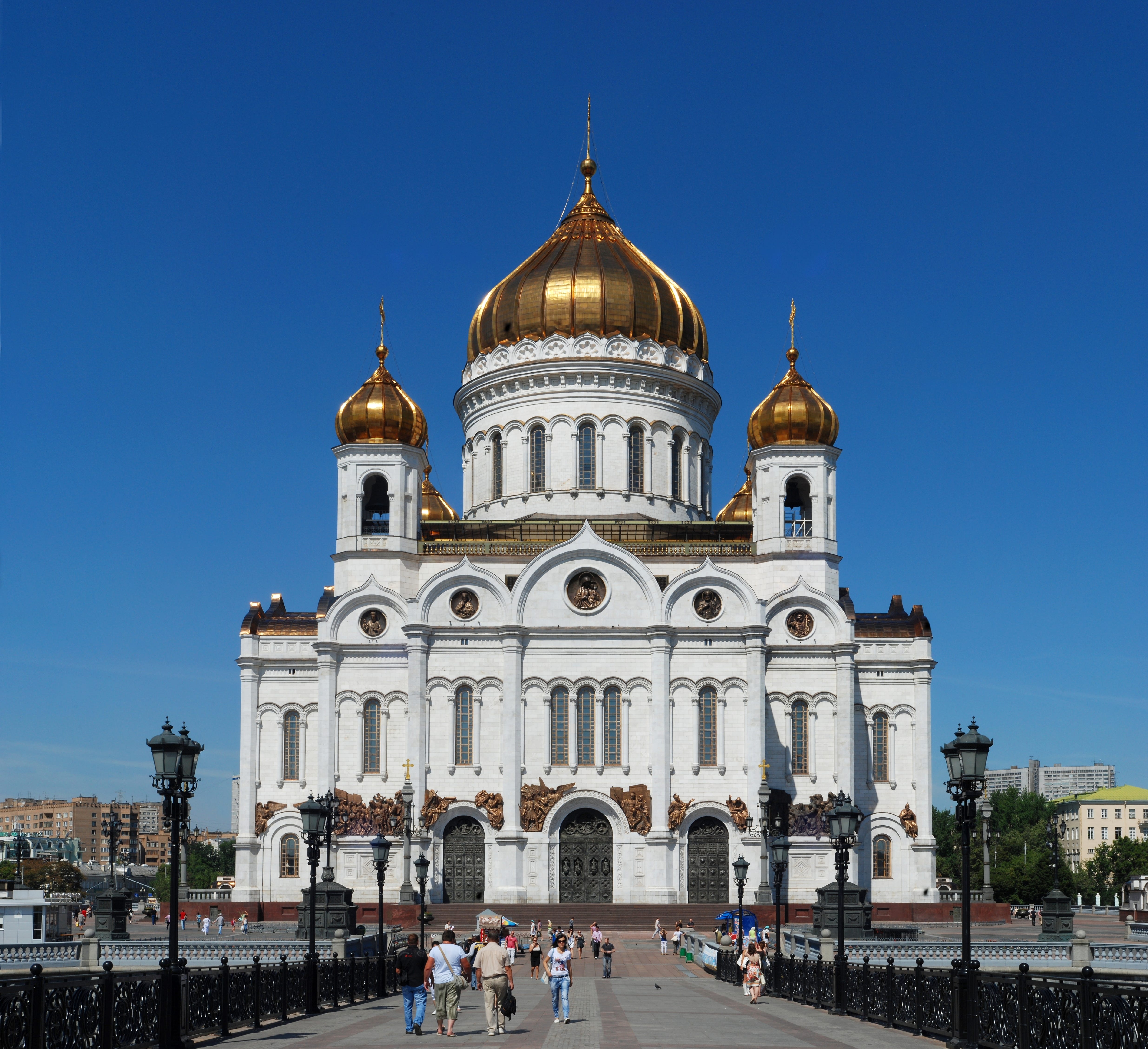
Image: Cathedral of Christ the Saviour, Moscow — the modern reconstruction (opened 2000) of the original cathedral built 1839–1883 to commemorate the Russian Empire's victory over Napoleon in 1812, the same victory Tchaikovsky's 1812 Overture (1880) was composed to celebrate. The original cathedral was demolished by Stalin in December 1931; the site became an outdoor swimming pool from 1958 to 1994; the reconstruction was completed in 2000 in faithful imitation of the original design. Photograph by Alvesgaspar (July 2011) via Wikimedia Commons, CC BY-SA 3.0.

Tonight across the country, fireworks will explode in time with Tchaikovsky’s 1812 Overture. The 1812 in the title is not the American 1812.
Two hundred and fifty years today.
Across the country tonight, in towns and cities the founders never heard of, on lawns and rooftops and beaches and parks, citizens will look up at the sky as orange and gold and white explosions bloom against the dark. Many of those displays will be choreographed to music. Many of those will use, at the climax, Pyotr Ilyich Tchaikovsky’s Festival Overture, the Year 1812 — the piece you know as the 1812 Overture, the one with the cannons.
It is the most American piece of music played in America that has nothing whatsoever to do with America.
Tchaikovsky composed it in 1880. He was forty years old, world-famous, and had accepted a commission from Nikolai Rubinstein to write a piece for the Moscow Arts and Industry Exhibition. The exhibition was timed to commemorate, among other things, the Russian Empire’s victorious defense against Napoleon Bonaparte’s invasion of 1812.
The 1812 in the title is the Russian 1812. Borodino. The burning of Moscow. The disastrous French retreat in winter. The line that broke Napoleon and started the chain of events that would put him on St. Helena three years later.
The piece is structured as a musical narrative of that campaign. It opens with the Russian Orthodox hymn O Lord, Save Thy People. It builds through battle motifs. It quotes the French Marseillaise — the revolutionary anthem — at the moment Napoleon’s forces are advancing. As the music turns, the Marseillaise is musically defeated. The climax delivers God Save the Tsar, the Imperial Russian anthem, triumphant over cannon fire that Tchaikovsky wrote into the score and over the toll of church bells he wrote in beside the cannons.
The piece, in other words, dramatizes the autocratic Russian monarchy defeating French revolutionary forces. It does this with literal cannons and literal church bells.
Tchaikovsky himself did not think much of it.
In a letter to his patron Nadezhda von Meck in October 1880, he described the piece as “very loud and noisy” and written “without warmth or love,” and predicted it would have “no artistic merit.” He was not exaggerating his own assessment. The piece was commissioned, written quickly, scored loud, and intended for outdoor performance with cannons and church bells at the 1882 Moscow exhibition.
It became one of the most performed pieces in the entire orchestral repertoire.
The American connection arrived ninety-four years later.
Arthur Fiedler, the conductor of the Boston Pops, was looking for a piece that would crown the Pops’ annual July 4 concert on the Charles River Esplanade in 1974 — the run-up to the 1976 Bicentennial. He chose the 1812 Overture. He arranged for real cannon fire from the Massachusetts National Guard’s 21st Regiment Artillery Group. He arranged for fireworks above the Esplanade choreographed to the music. The concert was televised. It became standard repertoire from there.
Today the 1812 Overture is so embedded in American Independence Day celebration that most Americans do not know what 1812 the title refers to, or whose victory the music celebrates, or that the cannons in the fireworks are echoing the cannons Tchaikovsky wrote to depict the cannons of Borodino fired by a Russian Imperial army that no longer exists in defense of a Russian Imperial monarchy that fell in 1917.
We celebrate American independence from a British monarchy with a piece of music that dramatizes a Russian monarchy defeating French revolutionary forces.
This is not a small irony.
Peace Racket would note: this is what happens when spectacle absorbs substance into atmosphere. The cannons are loud. The cannons are beautiful. The cannons demand nothing of the listener except awe at the cannons. The peace witness asks what the music is saying — and whether the citizen, set on quietly listening for the substance under the spectacle, is being underserved by the spectacle.
The line of witness has its own songs.
Amazing Grace. John Newton, written approximately 1772, sung the world over — no cannons, no Tsars, no defeated enemies. America the Beautiful. Katharine Lee Bates, drafted at the summit of Pikes Peak in 1893 — no cannons, no military victory, only the petition God mend thine every flaw, confirm thy soul in self-control, thy liberty in law. The Battle Hymn of the Republic. Julia Ward Howe, 1862 — apocalyptic in register, but the apparatus of war is named honestly, not dramatized for spectacle. Lift Every Voice and Sing. James Weldon Johnson, 1900 — the song the line of witness sings while it waits for the day true freedom comes. The spirituals — We Shall Overcome, Free at Last, Steal Away — sung from inside the catastrophes the apparatus produced, persistent across the centuries no autocracy could silence.
These songs are not loud. They do not have cannons. They are the songs the line of witness sings while the fireworks go off above the cannons of a Russian piece commemorating a Russian monarchy that no longer exists.
Tonight the fireworks will explode. Tomorrow the line of witness will continue.
The line is two hundred and fifty years old as of today. The next paragraph it writes is the paragraph you write.
Happy Fourth of July!
Peace Racket, Volume I is available in paperback, hardcover, and Kindle. Peace Racket, Volume II is being written now. The line of witness this project tracks runs from Adam Smith in 1759 to Martin Luther King Jr. in 1968, with the songs of the witnesses still being sung.