


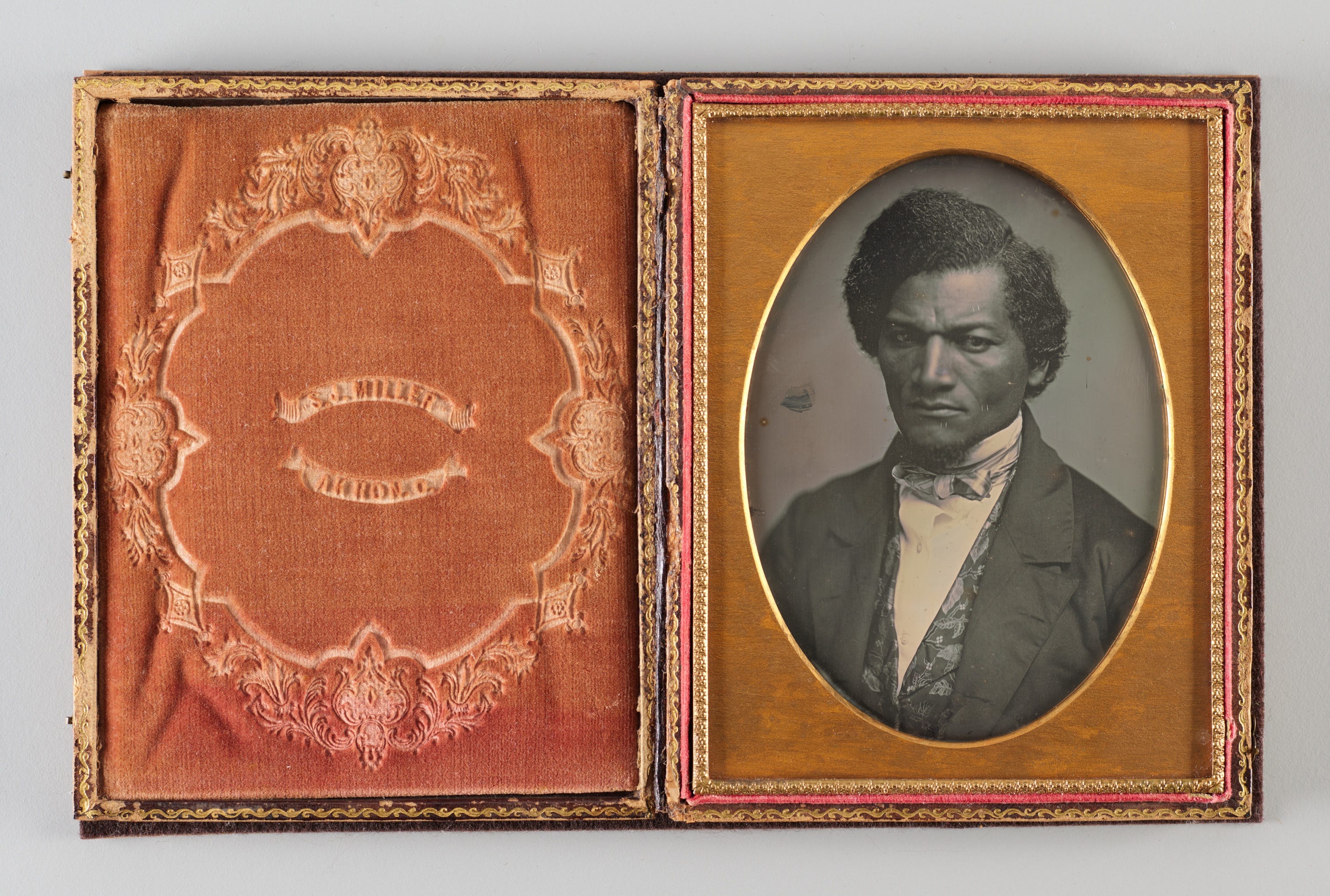
Image: Frederick Douglass, daguerreotype by Samuel J. Miller (Akron, Ohio), c. 1847–52, shown in its original presentation case. The portrait was taken approximately the same period in which Douglass delivered What to the Slave Is the Fourth of July? at Corinthian Hall, Rochester, on July 5, 1852. Douglass was one of the most-photographed Americans of the nineteenth century and used photography deliberately as an assertion of Black dignity. Art Institute of Chicago; public domain (CC0) via the Art Institute's open-access program.
This Fourth July is yours, not mine. You may rejoice, I must mourn.
— Frederick Douglass, Corinthian Hall, Rochester, New York, July 5, 1852
Yesterday America celebrated two hundred and fifty years of the Republic. Today is the one hundred and seventy-fourth anniversary of one of the most consequential addresses ever delivered on this continent.
Frederick Douglass stepped to the platform at Corinthian Hall in Rochester, New York on Monday, July 5, 1852, to speak to approximately six hundred members of the Rochester Ladies’ Anti-Slavery Society and their guests. He had been invited to give the Independence Day oration. He had taken the date as offered — July 5th — and delivered an address that, in its honest pairing of acknowledgment and counter-record, has stood for one hundred seventy-four years as the founding document of the American honest-counter-record genre.
He was thirty-four years old. He had been a free man for fourteen years. He had escaped slavery from the Eastern Shore of Maryland on September 3, 1838 at approximately twenty years old. He had been speaking publicly for the abolitionist cause since 1841. He had published the Narrative of the Life of Frederick Douglass, an American Slave in 1845. He had founded The North Star in Rochester in 1847. He had lived in Rochester since.
He had also, every July 4 for the previous fourteen Independence Days, watched the country celebrate a liberty no enslaved Black American held.
The address ran approximately ninety minutes and approximately ten thousand words. The structure of the address was deliberate.
The first half acknowledged the Founders’ work in the highest register American political-rhetorical tradition could produce. Douglass praised the signers of the Declaration. He praised their courage. He praised the Revolution as a structural break with the institutional configuration of monarchy that had preceded it. He praised the political-philosophical inheritance the Declaration had codified. He gave the Fourth of July, on its own terms, the full honor an American citizen could give it.
And then he pivoted.
He named the contradiction. He named the enslaved — approximately three and a half million human beings held in bondage by the same Republic the Declaration had inaugurated. He named the structural cost the Republic was extracting from the bodies of those held in slavery, every day, in every state of the Union where slavery was the institutional form. He named, in plain American English, what the Independence Day celebration did not name.
“What, to the American slave, is your 4th of July?” he asked the audience. “I answer; a day that reveals to him, more than all other days in the year, the gross injustice and cruelty to which he is the constant victim. To him, your celebration is a sham... There is not a nation on the earth guilty of practices, more shocking and bloody, than are the people of these United States, at this very hour.”
He delivered the diagnosis. He delivered the receipts. He named the cost the celebration was not naming.
“This Fourth July is yours, not mine. You may rejoice, I must mourn.”
The address has been studied for one hundred seventy-four years as a model of public-square rhetoric in the prophetic-political register. What the line of witness this project tracks recognizes in it is the structural move the address made.
Douglass did not refuse the Republic. He did not dismiss the Founders. He did not name the celebration as illegitimate. He named the celebration as honest only when it told the whole truth — the Founders’ work AND the cost of slavery, the Declaration AND the chains, the political-philosophical accomplishment AND the human beings still held in the antebellum South. He held both at once. He did not let the country off the structural argument by withdrawing from the celebration. He stayed in the conversation. He insisted on the honest counter-record.
This is the line-of-witness move at its highest register.
Smith named the moral foundation under the political economy in 1759 and 1776. Newton named the slave trade as wrong in 1788 from inside his own former participation in it. Burns named the dignity of the man under the rank in 1795. Bates named the country’s flaws beside the country’s beauty in 1893. Butler named the racket beside his own thirty-three years of Marine service in 1935. Eisenhower named the apparatus he had built across his Farewell of 1961. King named the war African-American servicemen were fighting at higher proportions than white servicemen across his Riverside Church address of 1967.
Each of these witnesses delivered the structural diagnosis from inside the institution they were diagnosing.
Douglass delivered the structural diagnosis from inside the body the institution had specifically inflicted itself on.
He died at home in Washington, D.C. on February 20, 1895, at approximately seventy-seven. He had been a Republican Party loyalist across the postwar decades. He had served as Marshal of the District of Columbia under Hayes, Recorder of Deeds for the District under Garfield and Arthur, and Minister Resident and Consul General to Haiti under Harrison. He had outlived emancipation by thirty years, Reconstruction by eighteen, and most of his original antislavery comrades by varying intervals. He had continued the public witness across all of it.
The address he delivered on July 5, 1852 has been published in pamphlets, anthologies, schoolbooks, and scholarly editions for one hundred seventy-four years. It is in the public domain. You can read the entire address tonight in approximately one hour.
Tonight would be a good night to read it.
Frederick Douglass is Chapter Six of Peace Racket, Volume II (being written now). Peace Racket, Volume I — available in paperback, hardcover, and Kindle — traces the line of witness from Adam Smith in 1759 forward through King in 1968. The next paragraph the line writes is the paragraph you write.