

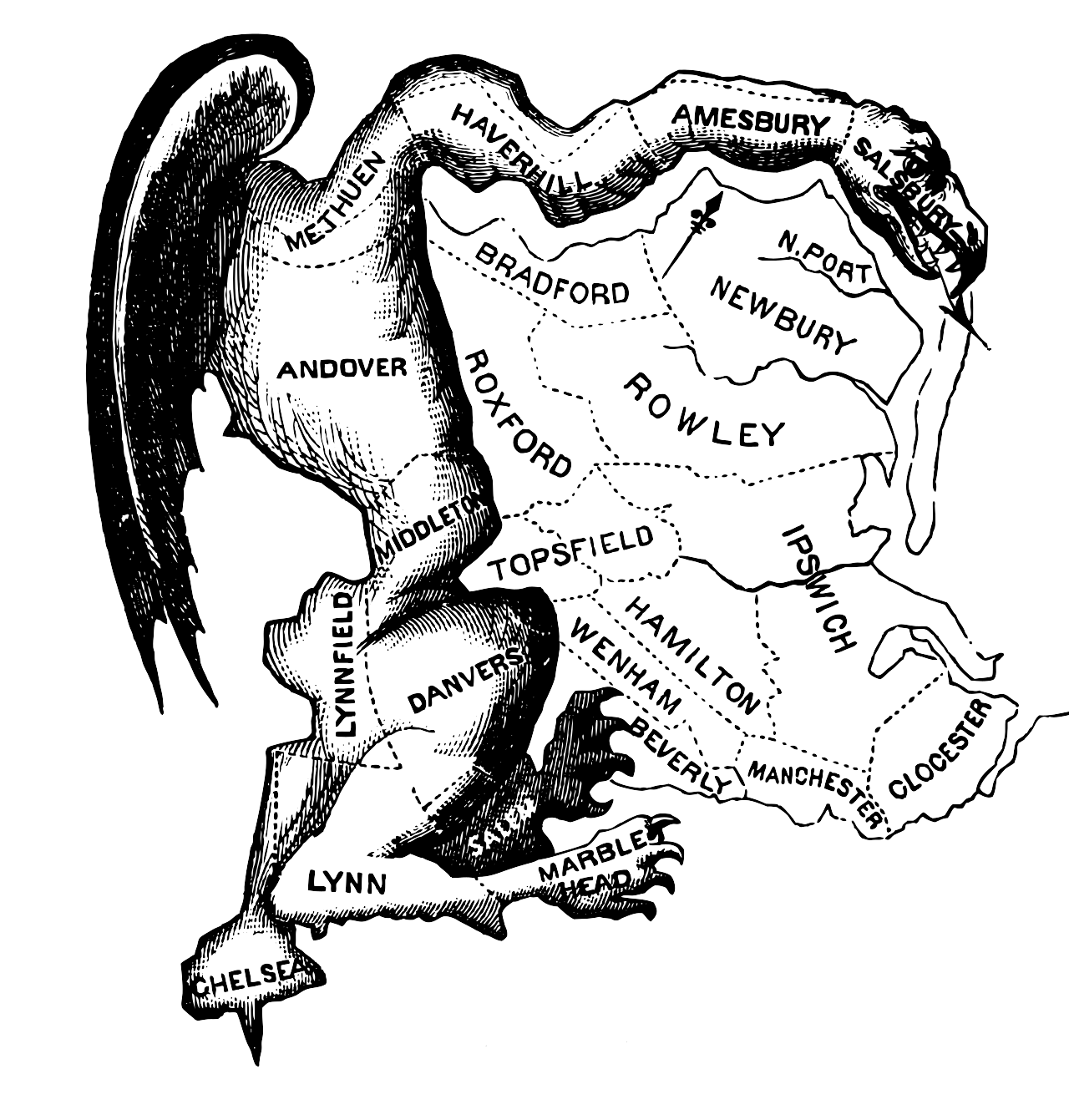
Image: "The Gerry-Mander," cartoon originally published in the Boston Gazette, March 26, 1812. Long attributed to the engraver Elkanah Tisdale, though attribution is contested. The cartoon depicts the newly drawn Essex County Massachusetts state Senate district — shaped to concentrate Federalist voters and advantage the Democratic-Republican party — as a winged salamander. The word gerrymander (Gerry + salamander) entered the American language within weeks. Modern vector rendering of the original cartoon; public domain by age. Available via Wikimedia Commons.

The limits of my language mean the limits of my world.
— Ludwig Wittgenstein, Tractatus Logico-Philosophicus 5.6 (1921)
On Monday of last week, Day 15 of this newsletter named a mechanism most modern American citizens no longer possess a working word for: sortition. Selection by lot. The Athenian invention Cleisthenes made structural in 508 BCE. The kleroterion at the Epigraphic Museum in Athens is the physical artifact.
Today’s missive is about the word itself.
Two hundred and fourteen years ago, on February 11, 1812, Governor Elbridge Gerry of Massachusetts signed into law a redistricting bill for the state Senate. Gerry was seventy years old, a signer of the Declaration of Independence, a signer of the Articles of Confederation, and a former delegate to the Constitutional Convention who had refused to sign the Constitution because he thought it needed a Bill of Rights. He was fifteen months from being sworn in as Vice President of the United States under James Madison. He would die in office in Washington on November 23, 1814.
The redistricting bill Gerry signed drew a state Senate district in Essex County in the shape of a long, twisting serpentine boundary. The bizarre outline was drawn to concentrate the state’s Federalist voters into as few districts as possible, so that the Democratic-Republican party — Gerry’s party — could win a majority of Senate seats with a minority of votes.
On March 26, 1812, the Federalist-aligned Boston Gazette published a cartoon by an unnamed artist — long attributed to the engraver Elkanah Tisdale, though the attribution is not certain — that depicted the district with wings, claws, and a fanged head. The caption named it: The Gerry-Mander.
The word entered the American language within weeks.
Two centuries later, most American citizens can define it in a sentence. Politicians manipulate district boundaries to advantage their own party at the expense of representative fairness. It is a specific practice with a specific name. When the practice appears, citizens have a word ready. They can point at it. They can critique it. They can demand reform.
This is what a word does.
Sortition is older by twenty-three hundred years.
The word comes from the Latin sortitio — the drawing of lots. It named a specific democratic mechanism used routinely in ancient Athens, in Renaissance Venice for parts of the doge selection process, in Renaissance Florence for a range of magistracies, and — with modifications — in modern jury selection systems around the world.
The word largely dropped out of everyday political vocabulary from the eighteenth century onward. The rise of elected representative government in the United States, in France after 1789, and across Europe through the nineteenth century displaced sortition as a live political idea. By 1900, most Americans, French, Britons, and Germans would have needed a definition. By 2000, most still would.
The mechanism did not disappear because it stopped working. The mechanism disappeared from the menu because the word disappeared from the vocabulary.
You cannot propose what you cannot name.
This is the Peace Racket move applied to civic language.
Butler in 1935 gave a generation the word racket to describe what was being done to it. Douglass in 1852 gave the honest counter-record its first American vocabulary by naming the Fourth of July as slaveholder-holiday. Erasmus in 1517 gave the Renaissance the phrase Querela Pacis — the Complaint of Peace — and turned peace itself into a speaker. Each was doing what the Boston Gazette cartoonist did on March 26, 1812. Each was putting a word into circulation so that the practice attached to it — good or bad — could be named, discussed, and either critiqued or demanded.
Vocabulary is not decoration on political thought. Vocabulary is the toolkit political thought works with.
Gerrymandering entered the toolkit in 1812 and stayed. Because Americans had the word, they could name the practice when they saw it. They could pass laws against it. Twelve states now use nonpartisan redistricting commissions of one kind or another. The word made the reform possible. Not sufficient — but possible.
Sortition left the toolkit somewhere around the American and French Revolutions. Modern citizens who have never encountered the word cannot ask their state legislature to try a citizen assembly, because they have no word to attach to what they are asking for. The Irish Citizens’ Assembly of 2016 to 2018 was possible because someone in Ireland still had the word. The French Convention Citoyenne pour le Climat of 2019 to 2020 was possible because someone in France still had the word. The British Columbia Citizens’ Assembly on Electoral Reform of 2004 was possible because someone in British Columbia still had the word.
The word is not the mechanism. The word is the door.
Putting sortition back into ordinary American civic vocabulary is a small structural act. It is the first act. Once the word is in circulation, the mechanism is available for citizens to propose to their city councils, their state legislatures, their governors, their neighbors. Some polities will try it. Some already have.
The volume the newsletter accompanies makes the same move a hundred different ways. Butler’s racket, Bates’s flaws beside beauty, Newton’s naming of the slave trade in his own former voice, Marshall’s equal protection argued live before the Supreme Court in 1952 and 1953 — each is a word or phrase put into circulation so that the practice attached to it could enter the room of things a citizen can name, propose, or demand.
Any night is a good night to add a word to your vocabulary that a citizen a century ago did not have.
Sortition. You have it now. Do with it what you will.
The recovery of civic vocabulary is one of the small structural moves Peace Racket, Volume I makes — available in paperback, hardcover, and Kindle. Peace Racket, Volume II is being written now. Every word put back into circulation is a door opened.
The next paragraph is the one you write.