

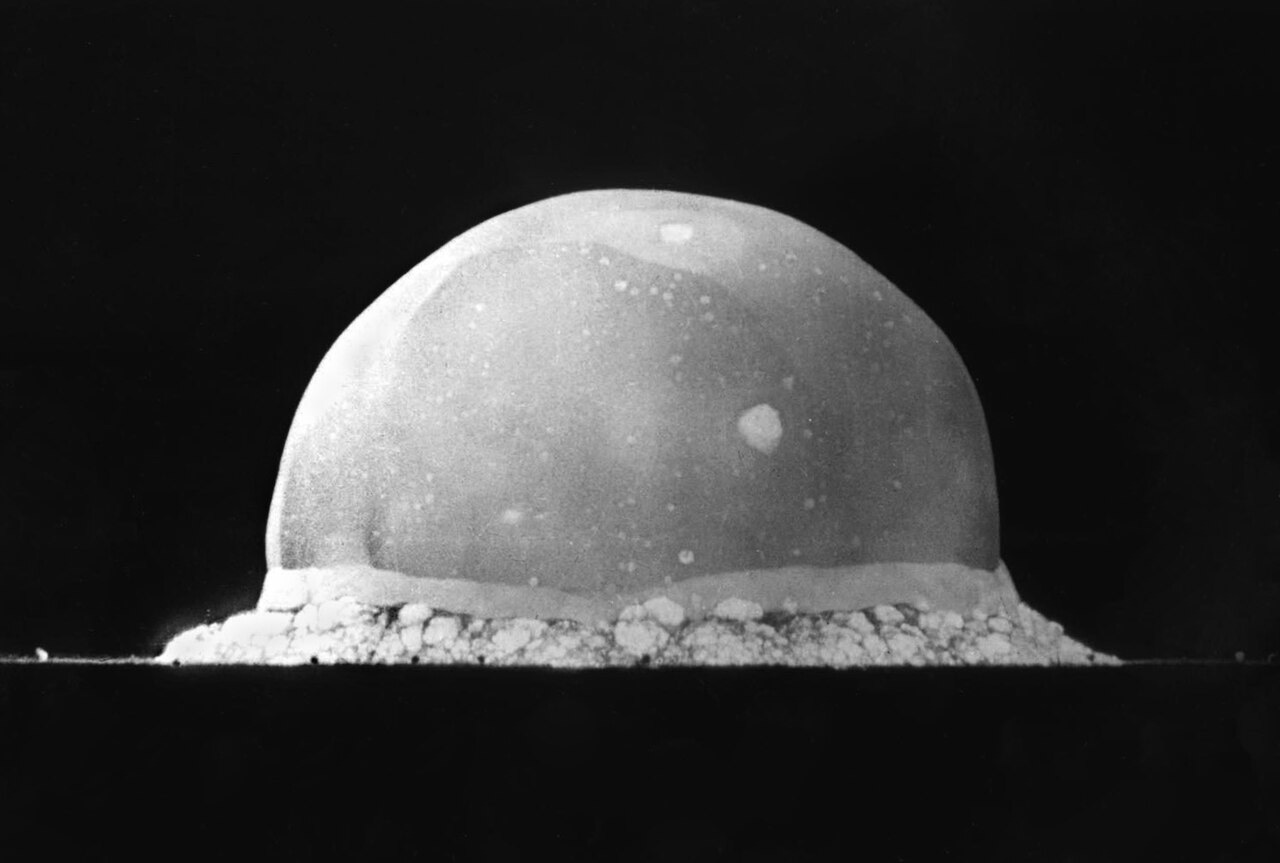
Image: The Trinity fireball at approximately sixteen milliseconds after detonation, July 16, 1945, 5:29:45 AM Mountain War Time, Jornada del Muerto, New Mexico. Photograph by Berlyn Brixner (Los Alamos Scientific Laboratory), taken with a Fastax high-speed camera at 10,000 frames per second. Public domain (17 USC § 105; federal government work product). Available via Wikimedia Commons.

A reader's note: This photograph is often seen and rarely looked at. If you have a moment, pause on it before continuing. The flat base of the dome is the shockwave already reflecting off the desert floor. The scattered points of light are sand and steel from the shot tower, thrown up and burning.
Now I am become Death, the destroyer of worlds.
— J. Robert Oppenheimer, recalling the passage from the Bhagavad Gita he thought of at Trinity, July 16, 1945
Today is the eighty-first anniversary of the moment humanity crossed a threshold that cannot be uncrossed.
At 5:29:45 in the morning, Mountain War Time, on July 16, 1945, in the Jornada del Muerto desert of central New Mexico — the Journey of the Dead Man, a name given to the region by Spanish colonial travelers in the sixteenth century for the difficulty of the crossing — the first nuclear weapon was detonated. The device, nicknamed the Gadget, was a plutonium implosion bomb. Its yield was approximately twenty-one kilotons of TNT equivalent. The fireball at the moment of detonation was hotter than the surface of the sun for a fraction of a second. The mushroom cloud rose to thirty-eight thousand feet. Sand at ground zero fused into a mildly radioactive green glass afterward called trinitite. Small fragments of it are still occasionally found by rockhounds in the New Mexico desert, though possession is now regulated.
The test was code-named Trinity. J. Robert Oppenheimer, scientific director of the Manhattan Project, chose the name after a John Donne sonnet — Batter my heart, three-person’d God — for reasons he later found difficult to explain even to himself.
Oppenheimer watched the detonation from base camp ten miles away. In an NBC television interview twenty years later, he recalled the passage from the Bhagavad Gita that he had thought of at the moment: Now I am become Death, the destroyer of worlds.
Kenneth Bainbridge, Trinity’s test director, standing beside him, said in plainer English: Now we are all sons of bitches.
Everything Peace Racket argues about apparatus, consent, honest counter-record, and the line of witness sharpens under a mushroom cloud.
Nuclear weapons are the apparatus at its purest. They are a machinery of mass killing whose maintenance requires the continuous consent of citizens who have almost no way to inspect what is being maintained on their behalf. Butler’s 1935 argument about the racket is small next to the Trinity fact of 1945. War as racket was one polity’s apparatus extracting from that polity’s people. Nuclear weapons are the same structural claim scaled to the level of the species.
The line of witness responded almost immediately.
August 2, 1939. Six years before Trinity. Albert Einstein and Leo Szilárd sign a letter to President Roosevelt warning that Germany may be pursuing an atomic weapon. Roosevelt authorizes preliminary research. The Manhattan Project follows.
July 17, 1945. One day after Trinity. Leo Szilárd circulates a petition among Manhattan Project scientists urging President Truman not to use the bomb against Japanese civilians without a demonstration and an opportunity for surrender. Seventy scientists sign. The petition is intercepted by General Groves and does not reach Truman before Hiroshima on August 6 or Nagasaki on August 9.
October 1945. Oppenheimer meets with President Truman at the White House. He says, quietly: “Mr. President, I feel I have blood on my hands.” Truman is offended. He later tells Dean Acheson never to bring “that cry-baby scientist” into his office again.
July 9, 1955. Bertrand Russell issues a manifesto co-signed by Albert Einstein a week before Einstein’s death. It is signed by eleven scientists, nine of them Nobel laureates. Its closing sentence: Remember your humanity, and forget the rest.
1957 onward. The Pugwash Conferences on Science and World Affairs, growing directly from the Russell-Einstein Manifesto, become the venue for scientific dialogue across the Cold War divide. Awarded the Nobel Peace Prize in 1995.
1947 forward. The Bulletin of the Atomic Scientists introduces the Doomsday Clock. Its current setting, announced January 2026, is eighty-nine seconds to midnight — the closest to the metaphorical global catastrophe in the Clock’s seventy-nine-year history.
Each of these witnesses did what Butler did. They named the racket from inside the apparatus that had produced it. Einstein signed the letter that helped start the Manhattan Project and then spent the last week of his life signing the manifesto that would define the postwar peace movement. Szilárd conceived the possibility of the chain reaction in 1933 and then petitioned against its use in 1945. Oppenheimer built the Gadget at Los Alamos and then testified for the rest of his life against the arms race he had made possible.
By the peak of the Cold War in the mid-1980s, the United States and the Soviet Union together held approximately seventy thousand nuclear warheads. The United Kingdom, France, and China had joined the club. Israel had become undeclared. India, Pakistan, and eventually North Korea followed. Nine nuclear-armed states exist today, holding roughly twelve thousand warheads between them — down significantly from the 1986 peak through arms control and post-Cold War drawdowns, but sufficient to end civilization many times over. And the trajectory is now upward again: American modernization, Russian new-system fielding, Chinese buildup toward parity.
The doctrine that governed the system was old. The Roman writer Vegetius put it in the fourth century CE: Si vis pacem, para bellum — if you would have peace, prepare for war. The nuclear version acquired its specific name at the Pentagon in the early 1960s under Secretary Robert McNamara: Mutually Assured Destruction. The strategic logic was that no state would initiate a nuclear war it could not survive, and that therefore massive retaliatory capacity was itself the guarantor of Great Power peace. The acronym was MAD, and its architects were not unaware of the joke.
The MAD peace held. From 1945 to today, the Great Powers have not fought each other directly. That is a genuine achievement. It is also an eighty-one-year exercise in maintaining peace through the constant threat of civilizational annihilation. Peace as working condition — the argument the volume the newsletter accompanies makes — is not the same as peace as MAD equilibrium. One is peace as the medium in which ordinary human life flourishes. The other is peace as the fear that stays the hand at the button. Both prevent war. Only one is peace in any register the human witnesses of the last three thousand years would have recognized.
The Trinity site is still there. Ground zero at the Jornada del Muerto. It is opened to the public twice a year — the first Saturdays of April and October — for a few hours. A modest obelisk marks the spot where the Gadget was detonated. It is quiet. The Jornada is quiet. The desert has almost, but not entirely, taken it back.
The line of witness continues, present tense. Each generation inherits what the previous generation did not manage to un-build. The Gadget is now a museum artifact. The apparatus it inaugurated is not.
Any night is a good night to remember what was crossed at Alamogordo eighty-one years ago, and what has been maintained since.
The nuclear age is one long test case of the volume the newsletter accompanies. Peace Racket, Volume I — available in paperback, hardcover, and Kindle — traces the line of witness from Adam Smith in 1759 forward. Peace Racket, Volume II is being written now. Every witness named in it is a witness against the day the Gadget was detonated. The next paragraph is the one you write.