


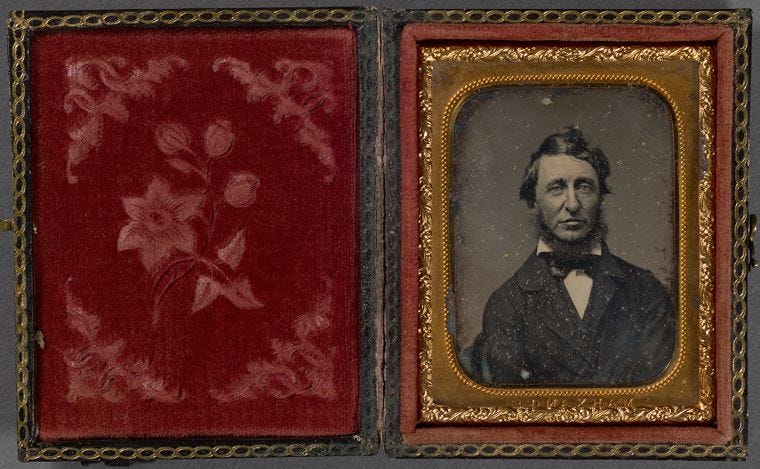
Image: Henry David Thoreau, daguerreotype by Benjamin D. Maxham, Worcester, Massachusetts, June 18, 1856, shown in its original ornate case. Thoreau sat for four small daguerreotypes that day at Maxham's studio and paid fifty cents for the set. Public domain by age. The New York Public Library Digital Collections; available at digitalcollections.nypl.org.
Let your life be a counter friction to stop the machine.
— Henry David Thoreau, Resistance to Civil Government (1849)
Today is the two hundred and ninth anniversary of the birth of Henry David Thoreau.
He was born in Concord, Massachusetts, on July 12, 1817. He lived forty-four years. He died of tuberculosis in the same house on Main Street in Concord on May 6, 1862, having just seen the country he loved enter the second year of the war he had spent his adult life warning would come.
Concord is a small town. Even now, at almost two hundred thousand people in the greater Boston metropolitan area, the Concord village center is walkable. The town green is a few hundred yards from the Old North Bridge, where the Revolutionary War began on April 19, 1775. The Thoreau house, the Emerson house, and the Alcott house are all within a half-mile of each other. The jail where the story we are telling today happened was on Main Street.
In July 1846, Henry Thoreau was walking into Concord village to pick up a shoe from the cobbler. On the way he was stopped by Sam Staples, the town constable and jailer, who reminded him that he had not paid his Massachusetts poll tax for six years. Thoreau said he did not intend to pay it. Staples said if that was the case he would have to arrest him. Thoreau said he understood.
Staples arrested him and walked him to the town jail.
Thoreau spent one night there. The next morning someone paid the tax on his behalf — probably his Aunt Maria, over his stated objection — and Staples released him. The story was that Thoreau was so angry about being paid out that he refused for a while to leave the cell.
The Mexican-American War had been declared two months earlier, on May 13, 1846. The tax Thoreau refused to pay funded, in part, that war. He considered the war unjust — an aggressive war of territorial expansion, driven substantially by the political interests of slaveholders seeking new slave states. He was not going to voluntarily contribute money to it.
That is the story.
What came out of the night in the Concord jail was the essay.
Thoreau delivered it first as a lecture at the Concord Lyceum on January 26, 1848, under the title The Rights and Duties of the Individual in Relation to Government. Elizabeth Peabody published it in May 1849 in the one and only issue of her journal Aesthetic Papers under the title Resistance to Civil Government. Thoreau’s sister Sophia included it in the posthumous 1866 collection A Yankee in Canada, with Anti-Slavery and Reform Papers, where an unknown editor gave it the title by which the world now knows it: Civil Disobedience.
The essay’s central claim is structural.
Government is a machine. Its motion is powered by the consent of the governed. When the machine is producing injustice — when the state, in Thoreau’s specific case, is prosecuting an unjust war — the individual citizen has a moral obligation to withhold consent. Not to petition the machine, not to vote for a different operator of the machine, not to write letters to the newspaper about the machine, but to stop feeding the machine. The tax collector arrives. The citizen declines. The machine slows.
Let your life be a counter friction to stop the machine.
This is the individual-consent argument in its most compressed American form. It is what Peace Racket, Volume I, calls the invisible-hand-of-peace argument approached from the individual scale: the countless small acts of consent that continuously power the apparatus can also be countless small acts of refusal, and when enough of them coincide, the apparatus slows.
The line of witness carried Thoreau’s essay onto two additional continents.
Mohandas Gandhi read Civil Disobedience while imprisoned in South Africa in the early years of his satyagraha — truth-force — campaign. He later called the essay his “textbook” on non-violent resistance. The strategic architecture of the 1930 Salt March, the 1942 Quit India Movement, and the Indian independence movement broadly is Thoreau’s essay elaborated at national scale.
Martin Luther King Jr. — Chapter Thirteen of the volume this newsletter accompanies — read Civil Disobedience as a student at Morehouse College. He wrote in Stride Toward Freedom in 1958 that reading it convinced him “that non-cooperation with evil is as much a moral obligation as is cooperation with good.” The Montgomery bus boycott of 1955 to 1956, the Birmingham campaign of 1963, and the strategic-nonviolent architecture of the American civil rights movement stand structurally downstream of the Concord jail cell.
Concord to Ahmedabad to Montgomery. Three cities. Three witnesses. One continuous philosophical inheritance.
Butler in 1935 named the racket from inside the apparatus that produced it.
Thoreau in 1849 named the individual’s refusal to feed the apparatus from outside it.
Both arrived at the same insight from different angles. The apparatus continues only as long as citizens continue to consent to it. Every ordinary act of consent — every tax paid, every vote cast, every enlistment signed, every cheer at the parade — is one small pulse of energy into the machine. And every ordinary act of refusal is one small pulse of the counter friction.
The apparatus is patient. The apparatus is old. But so is the refusal.
The refusal is available today, tomorrow, and next week. It has always been available. It is available to you.
Any night is a good night to sit with Thoreau.
Thoreau’s argument lives, present tense, in Martin Luther King Jr., Chapter Thirteen of Peace Racket, Volume II (being written now). Volume I traces the line of witness from Adam Smith in 1759 forward — available in paperback, hardcover, and Kindle. The counter friction is available to every citizen every day. The next paragraph is the one you write.