


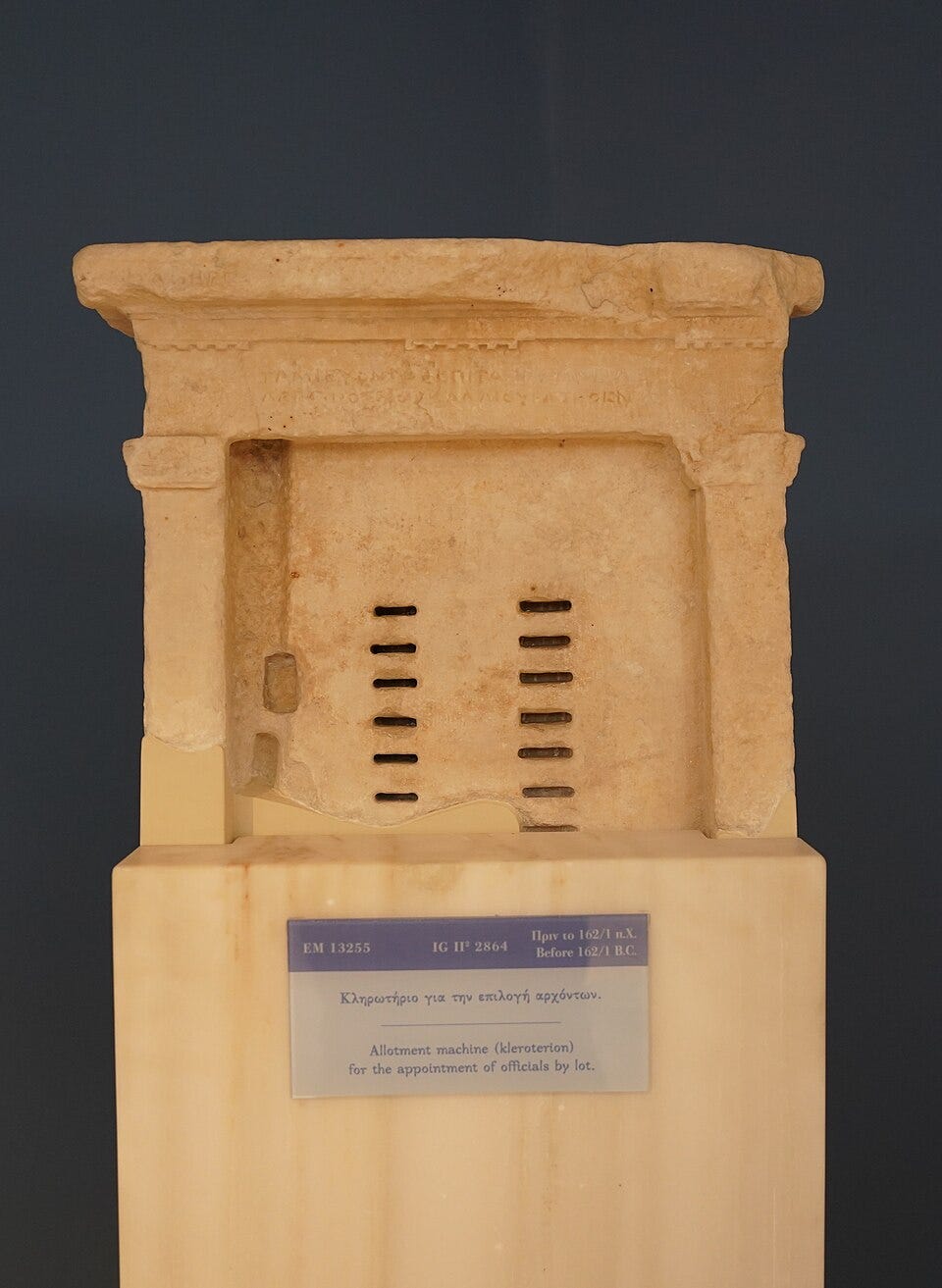
Image: Athenian kleroterion — allotment machine for the appointment of officials by lot. Marble, before 162/1 BCE (Epigraphic Museum, Athens, EM 13255; Inscriptiones Graecae II² 2864). Photograph originally on Flickr, migrated to Wikimedia Commons. License per Wikimedia Commons page.

It is thought to be democratic that offices should be filled by lot, and oligarchic that they should be elective.
— Aristotle, Politics IV.9 (c. 335 BCE)
Yesterday’s missive named the individual’s refusal to feed the machine. Today’s missive names one of the structural mechanisms by which citizens can construct legitimate collective decision in the first place.
In 508 BCE, in Athens, Cleisthenes reorganized the political structure of the polis around one of the most consequential democratic innovations in human history: selection by lot. The Athenian Boule — the council of five hundred that set the agenda for the Assembly, prepared legislation, and administered the polis on a day-to-day basis — was staffed by citizens chosen randomly from the demes of Attica. Farmers, potters, sailors, olive-oil merchants. Each served one year. Rotation was continuous.
Ancient Athens did not invent voting. Ancient Athens invented the deliberate use of random selection to prevent the wealthy and the rhetorically gifted from concentrating political power at the expense of everyone else.
The technology of the selection was a small stone machine called the kleroterion, which we named on Day 10 of this newsletter. Citizen identity tokens were slotted into columns; the machine’s random selection mechanism produced the day’s jurors, councilors, and magistrates. Surviving kleroteria are held at the Epigraphic Museum and the Ancient Agora Museum in Athens. You can visit them.
Here is how the machine actually worked. Each Athenian citizen carried an identity ticket — a pinakion, a small bronze plate engraved with his name, his father’s name, and his tribe. On mornings when officials were to be selected, citizens seeking to serve came to the Agora and handed their pinakia to the archon of their tribe. The tickets were inserted into the columns of the kleroterion, organized by tribe — a row across the machine held one citizen from each of the ten tribes at once. A magistrate then poured black and white balls into a bronze funnel attached to the machine. The balls emerged one at a time from a channel at the base. Each ball corresponded to a horizontal row of pinakia. A white ball meant the citizens in that row were selected for the day. A black ball meant they went home. The whole procedure happened in public. Any citizen could stand and watch. Any manipulation would have had to happen in front of everyone.
Aristotle observed the political principle in Politics Book Four, around 335 BCE:
It is thought to be democratic that offices should be filled by lot, and oligarchic that they should be elective.
The observation is structural. Elections tend to select for the qualities that win elections: money, name recognition, media access, rhetorical skill, tribal loyalty. Sortition selects for something else — for the demographic microcosm of the polity itself. A citizen assembly chosen by lot is, statistically, a representative sample of the population that convened it. Its starting opinions are the opinions the population holds. Its deliberation, over months, is the deliberation the population would produce if given the same time, the same experts, and the same room.
That is the innovation Cleisthenes made in 508 BCE. That is the innovation the modern world has been rediscovering in the twenty-first century.
The recent record.
Ireland — Citizens’ Assembly on the Eighth Amendment. October 2016 to April 2018. Ninety-nine ordinary Irish citizens, randomly selected to be broadly representative of the population, plus a chair. Met on weekends across eighteen months. Received expert testimony from doctors, lawyers, and ethicists spanning the range of Irish opinion. Deliberated. Voted. Recommended, by significant majority, that the constitutional prohibition on abortion be repealed and replaced with a legislative framework. The Irish government held the referendum. On May 25, 2018 the country voted yes, sixty-six point four percent to thirty-three point six percent. Ireland’s current legal framework is a framework proposed not by a party platform but by ninety-nine randomly selected citizens who sat and read and listened and thought.
France — Convention Citoyenne pour le Climat. October 2019 to June 2020. One hundred and fifty French citizens randomly selected. Deliberated across nine months on how France should reduce greenhouse gas emissions by at least forty percent by 2030. Produced one hundred and forty-nine specific proposals. Some were adopted; some modified; some rejected. What the process demonstrated is that ordinary French citizens, given the time and the expert briefing, were willing to propose more ambitious climate action than the elected government was willing to enact.
British Columbia — Citizens’ Assembly on Electoral Reform. 2004. One hundred and sixty randomly selected British Columbians met for eleven months and recommended a single transferable vote system. The 2005 referendum received fifty-seven point seven percent support — short of the sixty-percent threshold the government had set. The recommendation did not pass into law. What remains, twenty-two years later, is the record: fifty-seven point seven percent of a provincial electorate supported a proposal produced by one hundred and sixty of their fellow citizens sitting in a room.
Iceland — National Assembly and Constitutional Council. 2010 to 2011. Nine hundred and fifty randomly selected Icelanders met to propose the values that should guide a new constitution. A twenty-five-member Constitutional Council then drafted the document.
The pattern across all of these: give ordinary citizens the time, the expert briefing, and the room to deliberate — and they produce decisions of a quality the electoral machinery struggles to produce on its own.
This is the Peace Racket move applied to the polity itself.
Peace is a working condition that requires maintenance. Maintenance requires legitimate collective decision-making. Electoral democracy is one mechanism, and it has produced enormous benefits over the centuries. It has also produced predictable pathologies: fundraising as the price of entry, polarization as the strategy of victory, gridlock as the frequent result. Sortition-based citizen assemblies are a complementary mechanism — not a replacement — that add to the polity’s structural capacity for good decisions on questions the electoral machinery cannot easily handle.
Peace is the deliberation ordinary citizens are capable of when they are given the conditions to deliberate.
The invitation is not to abolish elections. The invitation is to widen the toolkit of legitimate collective decision-making so that peace has more surfaces on which to be maintained.
Every citizen already qualifies for the room. The room is not reserved for the credentialed or the wealthy or the loud. The room, when it is convened, is filled by the same statistical process that decides who sits on the jury when someone in your county is on trial.
The room the Athenians built is available.
Any citizen can begin to ask that their polity convene it.
The peace of deliberation is one thread of the broader argument Peace Racket, Volume I makes — available in paperback, hardcover, and Kindle. Peace Racket, Volume II is being written now. The line of witness continues, and the next paragraph is the one written by ordinary citizens sitting in a room together. That paragraph could be one written by you.