

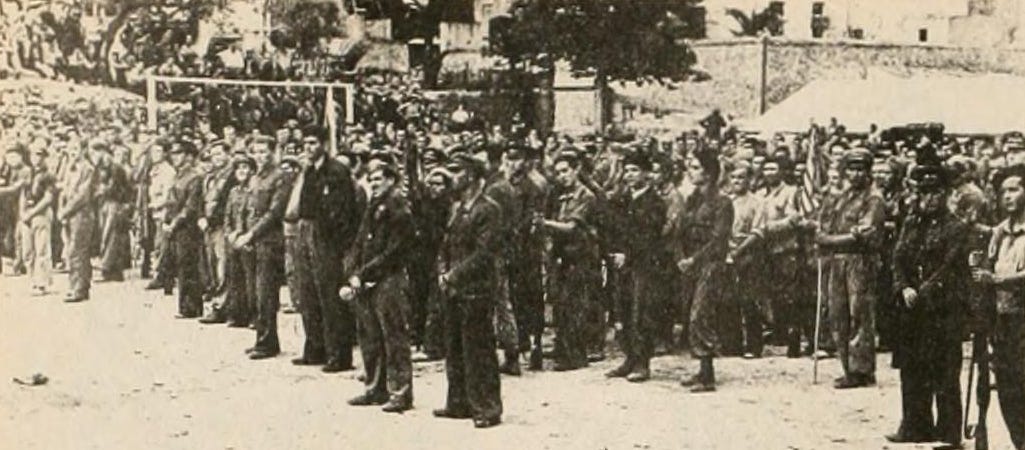
Image: Last parade of the Abraham Lincoln Brigade, Spain, 1938. American volunteers of the XV International Brigade at their formal farewell prior to withdrawal from the Spanish Republic. Public domain. Available via Wikimedia Commons.

¡No pasarán! They shall not pass.
— Dolores Ibárruri Gómez (”La Pasionaria”), radio broadcast from Madrid, July 19, 1936, the day after the coup
Ninety years ago yesterday, in Spanish Morocco, a group of Nationalist military officers launched an uprising against the elected Republican government of Spain. Ninety years ago today, the uprising reached the Peninsula. What had been a Moroccan military mutiny on July 17, 1936 became a Spanish war on July 18.
General Francisco Franco flew from the Canary Islands to Morocco to take command of the Army of Africa. General Emilio Mola launched the northern rising. Within days approximately half of Spain’s territory had fallen under Nationalist control. The other half — including Madrid, Barcelona, and the Basque and Catalan regions — held for the Republic.
The Republic had been proclaimed only five years earlier, on April 14, 1931, after Spain’s King Alfonso XIII went into exile following municipal elections that revealed how thoroughly the country had turned toward republican government. The intervening five years had been years of reform, resistance, and increasingly bitter polarization. The February 1936 elections had returned a Popular Front coalition of Republicans, Socialists, and Communists. The Nationalist coup was the military’s response to that election.
The war lasted almost three years. It ended on April 1, 1939 with a Nationalist victory. Franco ruled Spain until his death on November 20, 1975.
The Spanish Civil War is the twentieth century’s rehearsal for the Second World War.
Nazi Germany and Fascist Italy supplied Franco’s Nationalists with aircraft, tanks, tank crews, air crews, artillery, and personnel — most consequentially the Condor Legion of the Luftwaffe, which arrived in November 1936 and remained until the end of the war. The Soviet Union supplied the Republicans with aircraft, tanks, advisors, and NKVD political officers. Mexico supplied arms and refuge. The Western democracies — Britain, France, the United States — signed a Non-Intervention Agreement in August 1936 that pretended the war was Spain’s domestic affair while Germany and Italy actively supplied Franco. The pretense was known to be a pretense at the time.
The war saw the first industrial-scale terror bombing of European civilians. On April 26, 1937, the Condor Legion bombed the Basque market town of Guernica during a market-day afternoon. Approximately 250 to 1,600 civilians were killed — the exact figure is contested, but the political and moral impact was not. Pablo Picasso, working in Paris, painted his mural response between May and June 1937 and exhibited it at the Paris International Exposition that summer.
The world was watching. Some of the world was writing it down.
The international volunteers came.
Approximately thirty-five thousand foreign volunteers, from over fifty countries, joined the International Brigades organized under Comintern auspices to fight for the Spanish Republic. The Abraham Lincoln Brigade of American volunteers numbered approximately twenty-eight hundred. Roughly seven hundred and fifty of them died in Spain. They fought at Jarama, Brunete, Belchite, Teruel, and the Ebro. They were disbanded and repatriated in September 1938 after the Republican government asked all foreign volunteers to withdraw in a final attempt to force German and Italian withdrawal from the Nationalist side. The withdrawal did not force a matching withdrawal. The Republic fell six months later.
The line of witness ran deep.
George Orwell — Eric Arthur Blair — arrived in Barcelona in December 1936, initially to write newspaper articles. He joined the POUM (Partido Obrero de Unificación Marxista) militia almost immediately. He was shot through the throat by a Nationalist sniper at the front near Huesca in May 1937. He recovered. He returned to Barcelona to find the POUM being purged by Communist forces as suspected Trotskyists. He and his wife fled Spain. He wrote Homage to Catalonia, published in 1938. It is one of the truest books ever written about war by a person who fought in it.
Ernest Hemingway arrived as a correspondent for the North American Newspaper Alliance in March 1937. He wrote dispatches. He collected material. He returned to Cuba in 1938 and wrote For Whom the Bell Tolls, published in 1940. Robert Jordan, the American dynamiter of the Spanish Republican side, was fiction — but the moral geography of the novel was recorded from the ground.
Robert Capa photographed the war from September 1936 onward. His photograph The Falling Soldier — a Republican militiaman at the moment of being shot, September 5, 1936, near Cerro Muriano — became one of the most reproduced war photographs of the twentieth century. Whether the photograph is authentically what it claims to be has been debated since the 1970s. What is not debated is that Capa was there.
Simone Weil, the French philosopher, joined an anarchist militia briefly in August 1936. She was injured by boiling oil in a cooking accident and returned to France. She wrote about the experience in Letter to Georges Bernanos (1938). What she saw, she said, was that the war on the Republican side was also being conducted with cruelty. The honest counter-record within the honest counter-record.
Federico García Lorca, the Spanish poet, was murdered by Nationalist forces near Granada on approximately August 19, 1936. He was thirty-eight years old. One of the first cultural casualties.
The Republic lost.
That is the fact the peace-witness tradition has to hold honestly. Franco won. Fascism prevailed on the peninsula for thirty-six years. The volunteers who died at Jarama and Brunete died in a losing cause. The witnesses who wrote it down did not save the Republic they wrote about.
But they wrote it down.
Orwell’s Homage to Catalonia has never gone out of print. Hemingway’s For Whom the Bell Tolls is still assigned. Picasso’s Guernica hangs at the Museo Reina Sofía in Madrid, where any citizen of the country Franco once ruled can walk in for free on Sunday afternoons and look at what a fascist air force did to a Basque market town in April 1937. The Republic lost. The witnesses did not.
And the volume the newsletter accompanies makes an honest counter-record within its own argument. Peace Racket names peace as a working condition and war as the racket that most often produces itself. But the Spanish Republican defense against Franco’s coup was not a racket. Some wars are not. Some wars are the ones Butler set aside in War Is a Racket — defense of homes, defense of the constitutional inheritance a people has chosen for itself.
The Republic lost. The distinction survives.
The Spanish Civil War is not a chapter of Volume II — the volume follows a specific set of witnesses forward — but Orwell, Hemingway, and the volunteers stand in the line the volume is tracking. Peace Racket, Volume I — available in paperback, hardcover, and Kindle — traces the argument. Peace Racket, Volume II is being written now. The line of witness continues. The next paragraph is the one you write.