

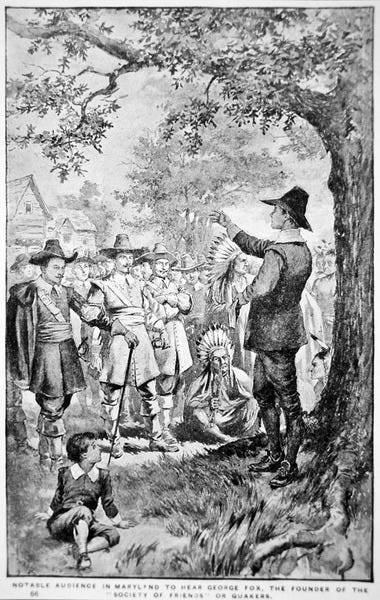
Image: "Notable Audience in Maryland to Hear George Fox, The Founder of the 'Society of Friends' or Quakers." Illustration from a late-19th or early-20th-century Quaker history text depicting George Fox's 1672 preaching tour of the American colonies. Fox addressed audiences including English settlers and members of local Native American communities during his travels; this illustration reflects the historical fact of those mixed gatherings, rendered in the illustrative conventions of the period in which the drawing was made. Public domain by age. Available via Wikimedia Commons.

A brief note on the cadence of this Substack: Peace Racket has been publishing daily through our launch arc. Beginning today, missives will publish regularly — with anniversaries and special dates producing bonus posts as they come. The launch arc built the foundation. Our new rhythm sustains it.
We utterly deny all outward wars and strife and fightings with outward weapons, for any end, or under any pretence whatsoever.
— Declaration of the Society of Friends to Charles II, January 1661
In January 1661, a small group of English Christians who called themselves the Religious Society of Friends — and whom their enemies called Quakers — delivered a document to the newly restored King Charles II. It was a declaration of their refusal to bear arms. Not against him. Not against anyone.
The document was drafted primarily by George Fox, the itinerant preacher who had founded the movement roughly a decade earlier, and by Richard Hubberthorne, one of Fox’s closest collaborators. It was addressed to the king because Charles had just returned from exile and was suspicious of any religious sect that might have supported the Cromwellian Commonwealth against his father. The Friends wanted to make their position unmistakable: they had not fought for Cromwell. They would not fight for Charles. They would not fight in any cause, for any end, under any pretense.
“We utterly deny all outward wars and strife and fightings with outward weapons.”
The Declaration is one of the founding documents of what is now called the peace testimony — the Society of Friends’ three-hundred-and-sixty-five-year commitment to refuse participation in war. It has never been rescinded.
The cost of the commitment was immediate.
Between 1660 and 1690 in England, approximately fifteen thousand Quakers were imprisoned for various refusals — refusal to bear arms, refusal to swear oaths, refusal to remove their hats before magistrates, refusal to pay tithes to the Church of England. Approximately four hundred and fifty died in prison from disease, cold, and overcrowding. Fox himself was imprisoned eight times.
In colonial Massachusetts, the persecution was worse. Between 1659 and 1661, four Quakers were hanged on Boston Common for the crime of returning to the colony after banishment: William Robinson, Marmaduke Stevenson, Mary Dyer, and William Leddra. Mary Dyer walked back to Boston knowing she would be executed. Her last recorded words: “My life avails me not in comparison to the liberty of the truth.”
The commitment continued.
George Fox himself visited the American colonies in 1672 and 1673, preaching in Barbados, Jamaica, and along the Atlantic seaboard from Rhode Island to North Carolina. In Maryland he addressed mixed audiences of English settlers and members of local Native American communities — a practice that would shape William Penn's approach to Pennsylvania nine years later.
William Penn, an English Quaker of aristocratic background, received a royal charter in 1681 for a colony that would test whether a peace-witness community could actually govern territory. He named it Pennsylvania — Penn’s Woods — for his father, and he called the founding project the Holy Experiment. Penn negotiated peace treaties with the Lenape rather than seizing land; those treaties held for approximately seventy years, longer than any other Anglo-Indigenous peace agreement of the colonial period.
John Woolman, a New Jersey Quaker tailor and traveling minister, published Some Considerations on the Keeping of Negroes in 1754 — one of the earliest sustained Christian anti-slavery arguments in America. Woolman personally traveled from Quaker meeting to Quaker meeting persuading Friends to free their enslaved workers. By 1776, most American Quakers had done so. The Society of Friends became the first religious body in the Anglophone world to require its members to renounce slaveholding.
Levi Coffin and Thomas Garrett, both Quakers, ran the two most important Underground Railroad stations of the antebellum period. Coffin in Indiana and Garrett in Delaware collectively helped an estimated five thousand people escape slavery. Both were prosecuted repeatedly; both continued the work anyway.
Bayard Rustin, born to a Quaker household in West Chester, Pennsylvania, in 1912, applied the Quaker peace testimony to the American civil rights movement. He introduced Martin Luther King Jr. to Gandhian nonviolence in 1956. He organized the 1963 March on Washington in eight weeks. He was gay in a movement that had not yet come to terms with that fact, and he paid a professional cost for it. He held the line anyway.
The institutional expression of the peace testimony arrived on April 30, 1917.
Three weeks after the United States entered the First World War — a war the Society of Friends had been publicly opposing — Quaker leaders in Philadelphia founded the American Friends Service Committee to give conscientious objectors constructive alternatives to military service. Members were sent to France to rebuild villages destroyed by war, to Russia during the famine of 1921–1923, to Germany to distribute food after the Armistice.
The AFSC continued that work through the interwar period, both World Wars, the postwar refugee crises, Vietnam, and every American war since.
On December 10, 1947 — Nobel Peace Prize day — the AFSC and its British counterpart, the Friends Service Council, were jointly awarded the Nobel Peace Prize “for their work for peace and international understanding.” Henry Cadbury accepted for the AFSC. He said: “Not by might, nor by power, but by spirit.”
That was the Quaker peace testimony delivered from the podium of the Norwegian Nobel Committee, two years after the Trinity test, in the year the Doomsday Clock was set for the first time.
The line of witness the volume the newsletter accompanies is tracking often runs through individuals — Butler, Douglass, Bates, King. The Quaker peace testimony is what happens when a community holds the line across three and a half centuries. It is one of the few sustained institutional peace-witness traditions in the modern West. It is religious in its origin but not sectarian in its application: AFSC has served, and been served by, people of every faith and none.
The Peace Racket claim that peace is a working condition requiring deliberate maintenance is not a new claim. The Quakers have been maintaining it since 1660.
Any evening is a good evening to sit with a tradition that has held the line for three hundred and sixty-five years.
The Quaker peace testimony is not a chapter of Volume II — the volume follows a specific set of individual witnesses forward — but Bayard Rustin sits directly inside King’s chapter, and the Quaker inheritance underwrites much of what Vol II tracks. Peace Racket, Volume I — available in paperback, hardcover, and Kindle — traces the argument across the fuller inheritance. Peace Racket, Volume II is being edited now. The line of witness continues. The next paragraph is the one you write.