

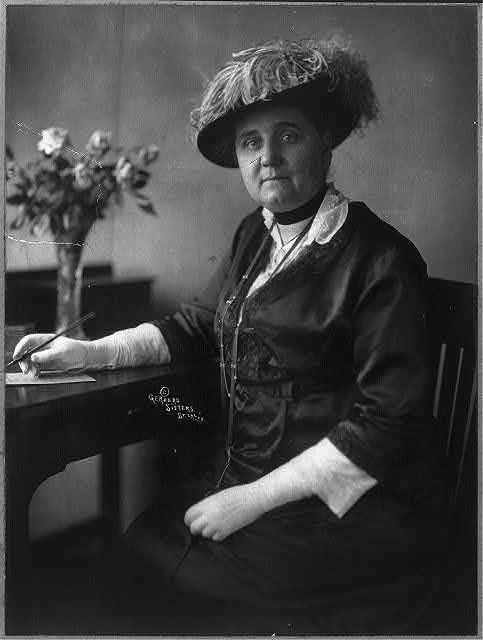
Image: Jane Addams at her writing desk, portrait by the Gerhard Sisters studio, St. Louis. Library of Congress, Prints and Photographs Division. Public domain by age. Available at loc.gov/item/2013651558.
The most dangerous woman in America.
— a label attached to Jane Addams by U.S. military intelligence and various patriotic organizations, circulated from 1917 through the 1920s
In 1917, a fifty-seven-year-old woman from Chicago was informed that she was, in the estimation of the United States military intelligence apparatus and several prominent patriotic organizations, the most dangerous woman in America.
Her name was Laura Jane Addams. She had been born in Cedarville, Illinois, on September 6, 1860, the daughter of a state senator who had been a personal friend of Abraham Lincoln. She had graduated from Rockford Female Seminary in 1881. In 1889 she had co-founded Hull House on Chicago’s Near West Side — one of the first and most influential settlement houses in the United States, providing education, childcare, health services, and civic training to the immigrant families of Chicago’s Nineteenth Ward.
In the intervening twenty-eight years she had co-founded the National Association for the Advancement of Colored People (1909, charter member), served as vice president of the National American Woman Suffrage Association, published Twenty Years at Hull-House (1910, and immediately a classic of American memoir), chaired the Woman’s Peace Party (1915), presided over the International Congress of Women at The Hague (April 1915) that gathered 1,136 women from twelve nations to advocate for a negotiated end to the war then raging, and traveled to the capitals of Europe carrying peace proposals to heads of state.
The label was for the peace work.
In April 1917, the United States entered the First World War. Addams did not.
She continued to advocate publicly for a negotiated settlement. She continued to speak against the mobilization. She continued to publish. The New York Times denounced her. The Daughters of the American Revolution — which had made her an honorary member in 1900 — expelled her. The Bureau of Investigation, predecessor to the FBI, opened a file on her that would eventually run to hundreds of pages. Military Intelligence Division agents attended her lectures and recorded her speeches. Various patriotic organizations circulated the most dangerous woman label until it acquired a life of its own.
For most of the decade and a half that followed, she was pushed out of the American mainstream. Speaking invitations that had been routine before 1917 stopped arriving. Foundations that had funded Hull House became cautious. She continued the work anyway. In 1919 she co-founded the Women’s International League for Peace and Freedom in Zurich. She served as its president from 1919 until 1929. She wrote Peace and Bread in Time of War (1922) about the moral and material cost of the pacifist witness during the war she had opposed. The book sold modestly. It has been in print, one way or another, ever since.
The rehabilitation was gradual.
By the mid-1920s, some of the WWI-era hysteria had subsided. Universities began inviting her again. Her writings on settlement work were reissued. She was, quietly at first and then less quietly, restored to the position of respected American public figure she had held before 1917.
On December 10, 1931, in Oslo, the Nobel Committee awarded the Nobel Peace Prize jointly to Jane Addams and Nicholas Murray Butler. Addams was seventy-one years old. She was recovering from surgery. She was too ill to travel to Oslo to receive the award in person. Her acceptance was read by a representative. She donated the prize money to the Women’s International League for Peace and Freedom.
She was the first American woman to receive the Nobel Peace Prize.
The country that had labeled her the most dangerous woman in America in 1917 was, in 1931, standing in the reflected honor of the Nobel Committee’s recognition of exactly what it had denounced her for.
She lived three and a half more years. She died on May 21, 1935, of colon cancer, in Chicago, three days after surgery. She was seventy-four.
This is what it can cost to be a peace witness during a war a witness’s country has chosen. The apparatus does not always kill. Sometimes it simply de-platforms and quietly waits.
Addams paid the cost of the fifteen-year exile because she believed, and continued to believe when her belief was expensive, that the moral case for peace does not acquire an asterisk when a country goes to war. What is wrong in Berlin is wrong in Washington. What is wrong in Paris is wrong in London. Killing is killing. The witness who says so during peacetime is respected. The witness who says so during wartime is denounced. Same witness. Same claim. Different apparatus response.
The line of witness the volume the newsletter accompanies is tracking includes the witnesses who paid the reputational cost. Butler paid a related cost when War Is a Racket was published in 1935 — the same year Addams died — and effectively ended his participation in the mainstream American military-political establishment he had spent thirty-three years serving. Douglass paid the cost of being called the moral scold of the Fourth of July for a decade after 1852. King paid a heavier cost in 1968 for exactly the same reason Addams paid it in 1917 — for insisting that the peace argument does not stop at the water’s edge.
Any of the witnesses could have made a career move. None of them did.
Any night is a good night to sit with the woman the U.S. Bureau of Investigation called the most dangerous woman in America.
Jane Addams is not a Volume II chapter — the volume follows a specific set of witnesses forward — but she stands squarely in the line the volume is tracking. Peace Racket, Volume I — available in paperback, hardcover, and Kindle — traces the argument. Peace Racket, Volume II is being written now. The line of witness continues. The next paragraph is the one you write.