

The wars come not because anyone wills them at the start but because at every step it is more expensive to stop than to continue.
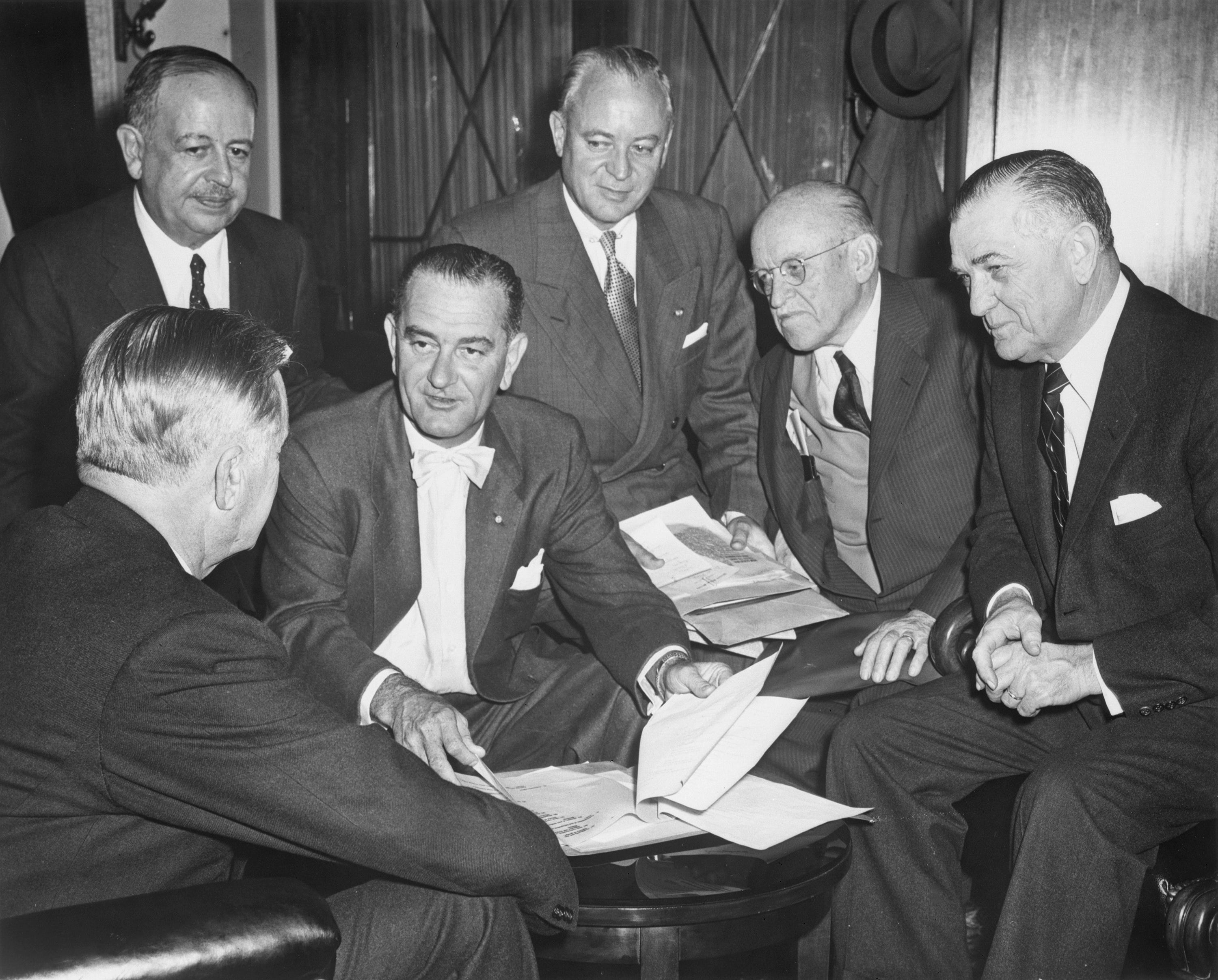
Image: Meeting of the Senate Preparedness Investigating Subcommittee, chaired by Senator Lyndon B. Johnson (D-TX), c. 1957–58. Convened after the Soviet launch of Sputnik on October 4, 1957, the subcommittee's hearings examined American defense readiness and produced the appropriations expansions that would build much of the postwar defense apparatus President Dwight Eisenhower would name in his Farewell Address of January 17, 1961. LBJ Presidential Library and Museum; public domain (federal government work product, 17 USC § 105). [LINK]
The United States is now more than two hundred and fifty years old. The Semiquincentennial. Ten generations and change since Jefferson and Adams and Franklin gathered with the others in Philadelphia and signed the document that began it.
I remember the Bicentennial. I was in third grade. We lived in New Haven, and that summer my parents drove me to the places where the country had begun. We touched the Liberty Bell — visitors were allowed to, then. We stood in Independence Hall where the Declaration was signed. My mother had been born in Philadelphia, first-generation American, and she had not seen those rooms herself until that summer either.
We drove to Plymouth Rock and learned it was not actually where the Pilgrims had first landed. We walked through Sturbridge Village watching the coopers and blacksmiths work the way the colony had worked. We rode through the Vermont mountains. The country was two hundred years old that summer. To a third-grader being shown it for the first time, it felt new. Awesome in the mind of an eight year-old.
The country is fifty years older now. And the country has built, in the half-century since I touched the bell, the most expensive war-making apparatus in human history.
The iron triangle is not a metaphor. It is a procurement strategy.
The F-35 fighter jet is the canonical American example. Final assembly is in Fort Worth, Texas. The engine is built by Pratt & Whitney in Connecticut — the state I was a third-grader in. The supply chain reaches more than 1,800 subcontractors across forty-five of the fifty states.
This was not an accident of where the right factories happened to be. It was the program's design.
When the F-35 hit its long string of cost overruns — the program's lifetime cost is now estimated at roughly 1.7 trillion dollars through 2070, making it the most expensive weapons system in human history — Congress did not cancel it. Congress could not cancel it. Each cancellation vote would have closed factories in dozens of states whose senators and representatives sit on the committees that fund the program. The same logic protects the M1 Abrams tank line in Lima, Ohio that the Army has at times told Congress it does not need. The same logic protects bases in districts whose representatives sit on the Armed Services committees.
This is what the pull quote means. The wars come not because anyone wills them at the start. They come because at every step the cost of stopping — the closed factories, the unemployed constituents, the canceled contracts — is higher than the cost of continuing.
The iron triangle is the contractor, the congressional committee, and the Pentagon, each acting rationally inside the structure the structure has built for each.
No conspiracy is required. The system is the conspiracy.
The third-grader who touched the Liberty Bell did not know about Fort Worth. He did not know that Pratt & Whitney, in the state where he lived, would build the engine of the most expensive weapon in human history. He did not know about Lima, Ohio.
The republic was supposed to be one in which the citizens decided whether to fight. Independence Day exists to honor that decision. The Iron Triangle is what has been built where that decision used to live.
The iron triangle's full anatomy — and what citizens can do with it — is in Peace Racket, Volume I. Available in paperback, hardcover and Kindle.