


Review of action makes many reported contacts and torpedoes fired appear doubtful. Freak weather effects on radar and overeager sonarmen may have accounted for many reports. No actual visual sightings by MADDOX. Suggest complete evaluation before any further action taken. — Captain John J. Herrick, Commander, Destroyer Division 192, aboard USS Maddox, cable to Commander in Chief Pacific Fleet, August 4, 1964.
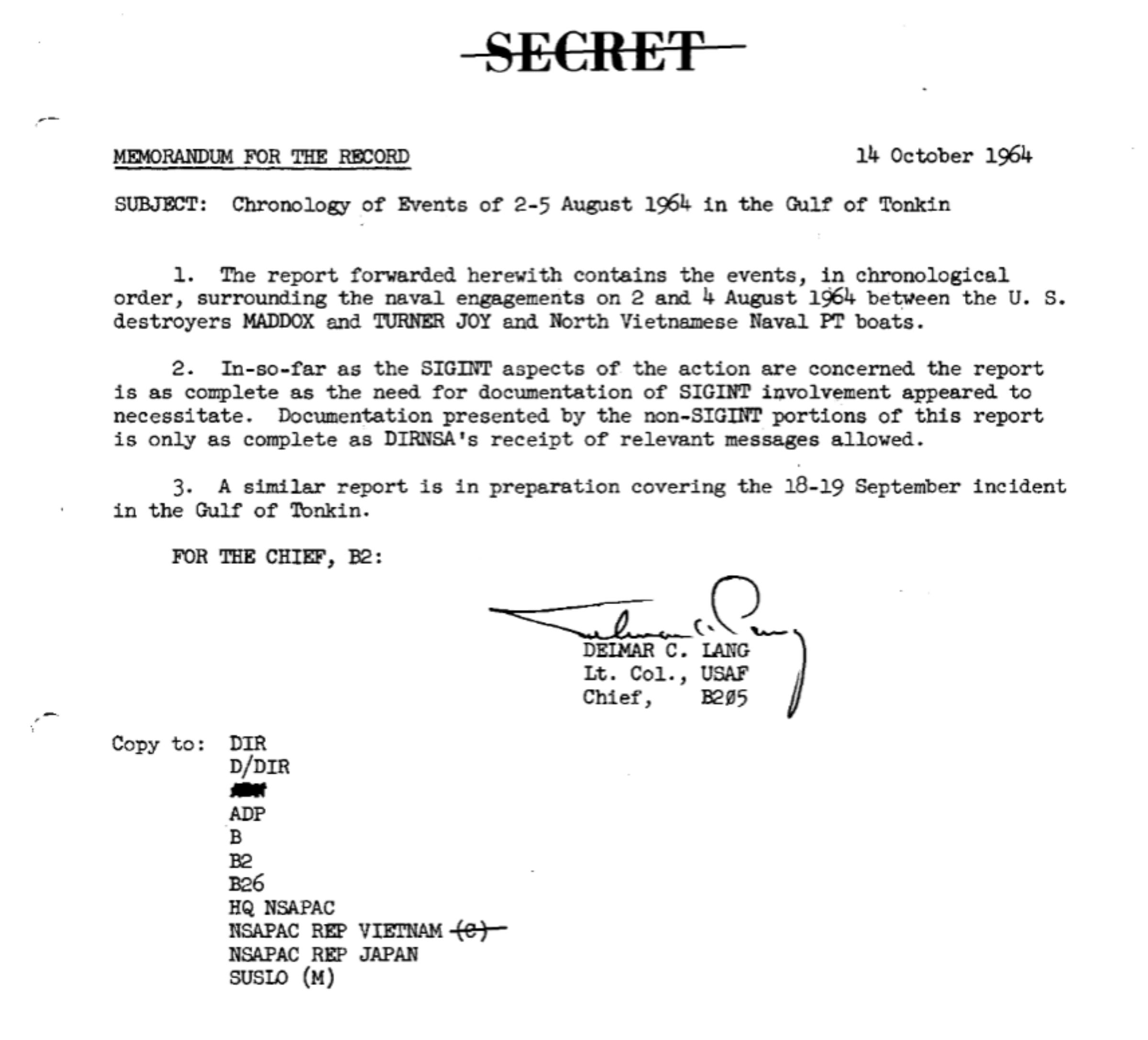
Image: Memorandum for the Record, "Chronology of Events of 2–5 August 1964 in the Gulf of Tonkin," 14 October 1964. Lt. Col. Delmar C. Lang, USAF, Chief B205. Declassified and released November 30, 2005 as part of the NSA's release of Robert J. Hanyok's study Skunks, Bogies, Silent Hounds, and the Flying Fish: The Gulf of Tonkin Mystery, 2–4 August 1964. The memo was internal correspondence covering an NSA chronology that acknowledged material discrepancies in the signals intelligence supporting the August 4 "second attack." Public domain (17 USC § 105). Source: National Security Archive, George Washington University, EBB 132.
Yesterday’s missive named the apparatus. Today’s missive shows what the apparatus produces.
On the afternoon of August 2, 1964, USS Maddox (DD-731), a Sumner-class destroyer conducting a signals-intelligence patrol in international waters in the Gulf of Tonkin, was engaged by three North Vietnamese P-4 torpedo boats. The engagement occurred. There is no dispute about August 2. Maddox fired warning shots, then aimed fire; F-8 Crusaders from USS Ticonderoga joined the action; two of the three P-4 boats were damaged; the Maddox took a single bullet strike to its superstructure. No American was killed. That was the actual engagement.
Two nights later, on August 4, in bad weather, the Maddox and USS Turner Joy (DD-951) reported a second attack.
Captain Herrick was aboard the Maddox. He sent the cable above the same day.
The cable was received in Honolulu and in Washington within hours. President Lyndon Johnson had it. Secretary of Defense Robert McNamara had it. The Joint Chiefs had it. The Senate Foreign Relations Committee did not.
On the evening of August 4, LBJ went on national television and announced retaliatory air strikes against North Vietnamese naval bases and an oil storage facility at Vinh. He did not mention Herrick’s cable.
On August 7, 1964, Congress passed the Southeast Asia Resolution — commonly called the Gulf of Tonkin Resolution — authorizing the President “to take all necessary measures to repel any armed attack against the forces of the United States and to prevent further aggression.”
The Senate vote was 88 to 2. Senators Wayne Morse of Oregon and Ernest Gruening of Alaska cast the two dissenting votes. The House vote was 416 to 0.
Combined: 504 to 2.
The resolution was the legal foundation for the full expansion of the Vietnam War.
By April 1969, U.S. troops in Vietnam peaked at approximately 549,500. By the fall of Saigon on April 30, 1975, approximately 58,220 American servicemen were dead. The Vietnamese, Cambodian, and Laotian dead across the wider conflict number in the millions — scholarly estimates commonly place total Vietnamese dead at two to three million, with additional heavy losses across Cambodia and Laos.
The August 4 attack did not happen.
This was not established in 1965 or 1975 or 1985. This was established inside the National Security Agency itself.
In 2000 and 2001, an NSA historian named Robert J. Hanyok completed a study titled Skunks, Bogies, Silent Hounds, and the Flying Fish: The Gulf of Tonkin Mystery, 2–4 August 1964. Hanyok reviewed the signals intelligence available on and after August 4, 1964. He concluded that the SIGINT reports supporting the second attack had been selected, translated, and presented in a manner that produced a false picture. Some intercepts had been misdated. Some had been mistranslated. The intercepts that would have contradicted the second-attack narrative had not been forwarded to decision-makers.
Hanyok’s conclusion, in his own sentence:
The overwhelming body of reports, if used, would have told the story that no attack had happened.
The Hanyok study was completed inside the NSA. It sat classified for approximately four years. It was declassified and publicly released on November 30, 2005, forty-one years after Herrick’s cable, under pressure from historians and the National Security Archive at George Washington University.
Secretary McNamara, interviewed by Errol Morris for The Fog of War in 2003, delivered the shortest version of the finding:
It didn’t happen.
The structural point is not that Johnson lied. That is a small point. The structural point is that the apparatus did not require a lie. The apparatus required only that a doubted report be treated as sufficient grounds. The commander on the destroyer being “attacked” cabled the same day that the attack was doubtful. The apparatus voted 504 to 2 to authorize the war anyway. The archives, the intercepts, the internal doubts — all of it stayed inside the classified system for forty-one years while the war was fought, lost, and grieved.
This is the line of witness the volume the newsletter accompanies is tracking. Butler in 1935: War is a racket. It always has been. It is possibly the oldest, easily the most profitable, surely the most vicious. It is the only one international in scope. It is the only one in which the profits are reckoned in dollars and the losses in lives. Butler was writing about the Spanish–American War and the First World War. He was describing, sixty years early, the same structural move that would produce the Southeast Asia Resolution on August 7, 1964.
The apparatus is patient. The apparatus is old.
The honest counter-record — that Herrick doubted the report the same day, that Hanyok said so in NSA’s own voice thirty-six years later, that McNamara said it didn’t happen on camera in 2003 — is the record we hold now. It was held inside the classified system while the consequence was being paid outside it.
Tonight is a good night to sit with that.
The Gulf of Tonkin is a chapter in the argument Peace Racket, Volume I makes — available in paperback, hardcover, and Kindle. Peace Racket, Volume II is being written now. The line of witness continues. The next paragraph is the one you write.