


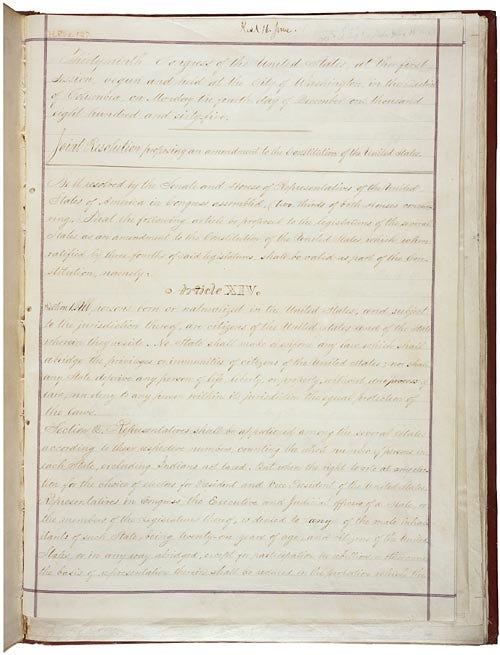
Citation: The House Joint Resolution Proposing the 14th Amendment to the Constitution, June 16, 1866; Enrolled Acts and Resolutions of Congress, 1789-1999; General Records of the United States Government; Record Group 11; National Archives. https://www.archives.gov/milestone-documents/14th-amendment
Nor shall any State deprive any person of life, liberty, or property, without due process of law; nor deny to any person within its jurisdiction the equal protection of the laws.
— Fourteenth Amendment, Section 1 (ratified July 9, 1868)
Today is the one hundred fifty-eighth anniversary of the ratification of the Fourteenth Amendment to the Constitution of the United States.
On July 9, 1868, South Carolina and Louisiana became the twenty-eighth and twenty-ninth states to ratify — enough to reach the three-quarters threshold Article V requires. Secretary of State William H. Seward certified the ratification on July 28, 1868.
What preceded it was the largest and costliest war ever fought on this continent.
Approximately seven hundred and fifty thousand Americans died in the Civil War of 1861 to 1865 — a figure revised upward by the demographic historian J. David Hacker in a 2011 study, from the long-standing estimate of approximately six hundred and twenty thousand. Two percent of the entire American population. In today’s proportional terms, approximately seven and a half million dead.
That is the cost the war extracted.
What the war produced structurally is the Thirteenth, Fourteenth, and Fifteenth Amendments. Three amendments in approximately fifty months.
December 6, 1865 — the Thirteenth Amendment is ratified. It abolishes slavery and involuntary servitude except as punishment for crime.
July 9, 1868 — the Fourteenth Amendment is ratified. It establishes birthright citizenship; guarantees privileges and immunities, due process, and equal protection of the laws to all persons; disqualifies from public office those who having taken an oath of allegiance to the Constitution then engaged in insurrection against it; validates the public debt of the United States and repudiates the debts of the Confederacy.
February 3, 1870 — the Fifteenth Amendment is ratified. It prohibits the denial of the right to vote on account of race, color, or previous condition of servitude.
Three amendments in fifty months. This is what the Civil War produced.
This is peace as constitutional architecture.
Not the peace that ended the war — that was Appomattox, April 9, 1865. The peace that came after: the constitutional inscription of what the war had cost, so the next generation would inherit the counter-record without having to fight for it again.
That was the intent.
The honest counter-record within the honest counter-record is that the intent did not hold.
The Slaughter-House Cases in 1873 narrowed the Privileges or Immunities Clause to near-irrelevance. The Civil Rights Cases in 1883 held that the Fourteenth Amendment did not reach private discrimination. Plessy v. Ferguson in 1896 sanctioned racial segregation under the “separate but equal” doctrine. Between 1877 and 1954, the equal-protection promise of the Fourteenth Amendment was substantially unavailable to the persons for whom it had been most specifically written.
Reconstruction did not end on a date. Reconstruction ended over decades, through Supreme Court decisions, state constitutional conventions, Klan violence, disenfranchisement statutes, and a federal will that first weakened, then withdrew. What survived under altered names was Jim Crow — Jim Crow as the political name for the systematic nullification of the very amendment ratified on this day one hundred fifty-eight years ago.
The amendment did not defend itself.
It took another line of witness to restore it.
Ida B. Wells named the lynchings in the 1890s. W.E.B. Du Bois named the color line in 1903. Thurgood Marshall — Chapter Eleven of the volume the newsletter accompanies — argued Brown v. Board of Education before the Supreme Court in 1952 and 1953, using the Fourteenth Amendment as his constitutional foundation. The Court decided May 17, 1954. The Civil Rights Act of 1964 and the Voting Rights Act of 1965 delivered the statutory enforcement the Fourteenth and Fifteenth Amendments had promised in 1868 and 1870.
Martin Luther King Jr. — Chapter Thirteen — delivered the moral witness that made the legislative action possible.
The line of witness is the line that carries the honest counter-record across the generations when the structure does not carry it on its own.
The Fourteenth Amendment continues, present tense, to guarantee equal protection of the laws. What it does today, it does because someone in every generation between 1868 and now decided to insist that the promise be kept. The amendment did not enforce itself. It never will. It is a text on paper. The people who wrote it are dead. The people who ratified it are dead. The people who defended it across the century between 1868 and 1968 are dead.
What is left of it is the promise — and the people who continue to insist that the promise be kept.
That includes you.
Tonight is a good night to sit with that.
The Fourteenth Amendment is the constitutional counterpart of the argument Peace Racket, Volume I makes — available in paperback, hardcover, and Kindle. Peace Racket, Volume II is being written now. Thurgood Marshall is Chapter Eleven; Martin Luther King Jr. is Chapter Thirteen. The line of witness continues. The next paragraph is the one you write.