


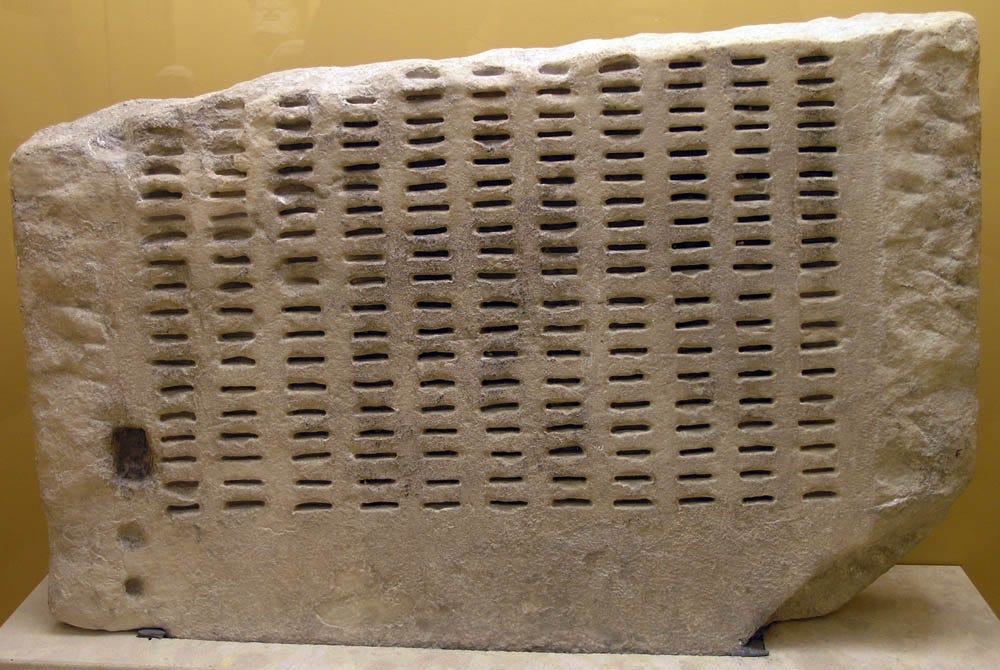
Image: Kleroterion (κληρωτήριον), the Athenian allotment machine used to randomly select citizens for jury and council service, c. 3rd–2nd century BCE. Bronze identification tickets (pinakia) inserted in the slots determined the day's selection by tribal row; a kleroterion stood in front of each Athenian court. Ancient Agora Museum, Athens. Photograph by Marsyas via Wikimedia Commons, CC BY-SA 2.5.

Sortition, the selection by lot, as Athens used for juries and offices, stands as the antidote to the career politician.
Athenian democracy did not run on elections.
It ran on lot.
The Council of Five Hundred — the Boule, the body that set the agenda for the assembly and managed the day-to-day business of the polis — was chosen by lottery from the citizen body, in annual rotation. The juries — the dikastēria, the bodies that tried cases and held public officials accountable — were chosen by lottery, in panels of two hundred and fifty to five hundred and one citizens, drawn fresh each day. Most of the magistrates, with the few specific exceptions for offices requiring military or technical expertise, were chosen by lottery.
Aristotle, in the Politics, named the distinction directly: selection by lot is democratic, selection by election is oligarchic. He was not describing an ideal. He was describing the working political practice of Athens and contrasting it with what he had observed in the more oligarchic poleis of the Greek world.
The reasoning was structural. A polity that elects its officials produces career officials. Career officials have rational incentives to maintain the system that made them officials, even when the system has become something the population needs to constrain. A polity that selects by lot produces officials who came from the citizenry, who will return to the citizenry, and whose tenure is short enough that capture is hard.
The modern descendants of the Athenian lot are the criminal jury, the citizen assembly, and the deliberative poll. Each works on the same principle: the ordinary citizen, given information and time, decides better than the captured legislature.
It is two thousand five hundred years old. It still works.
What the citizenry can do with the framers’ design — sortition included — runs through Peace Racket, Volume I. Available in paperback, hardcover, and Kindle. Volume II is being written.