

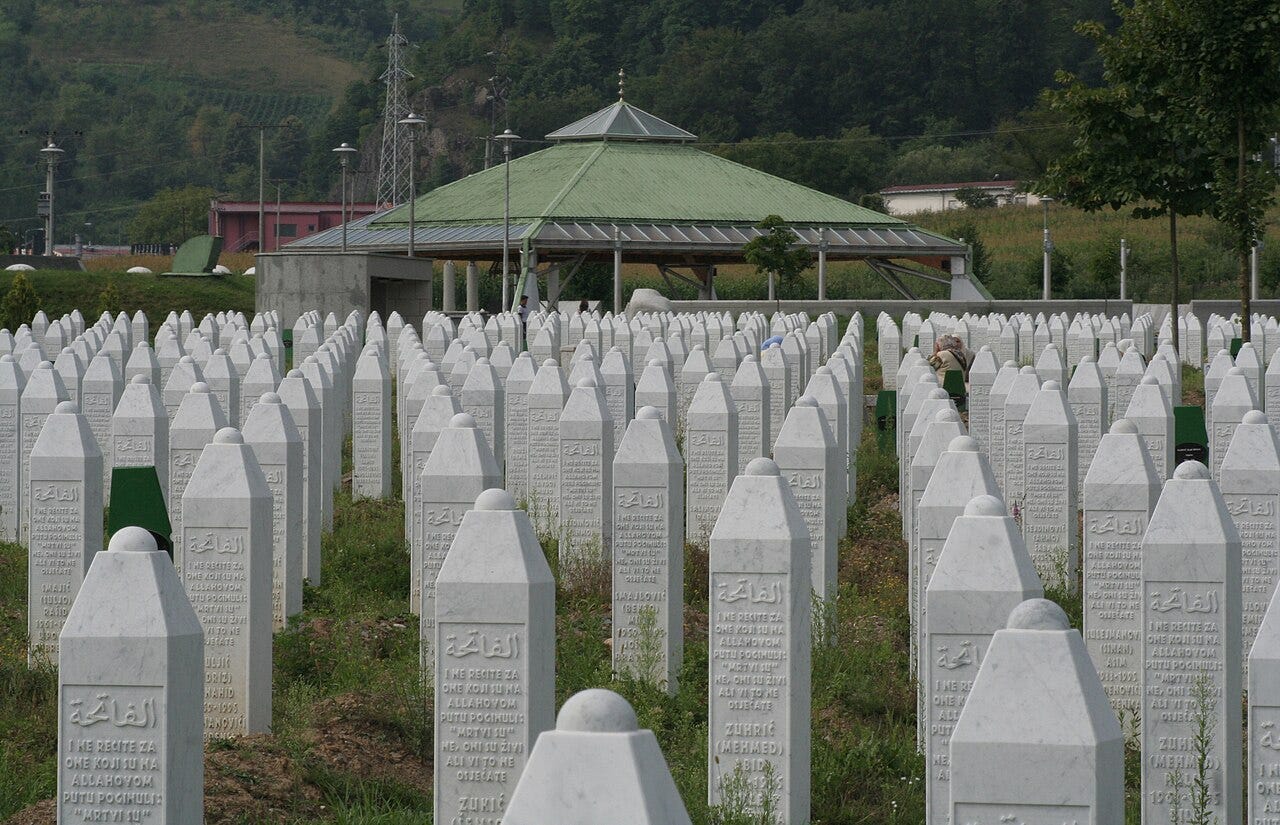
Image: The Srebrenica–Potočari Memorial Center, near Srebrenica, Bosnia and Herzegovina, photographed 2008. Established September 2003; site of the annual commemoration of the July 1995 genocide. Released into the public domain worldwide by the photographer. Available via Wikimedia Commons.

Through error, misjudgment, and an inability to recognize the scope of the evil confronting us, we tried to keep the peace and apply the rules of peacekeeping when there was no peace to keep.
— Kofi Annan, UN Secretary-General, The Fall of Srebrenica, report to the UN General Assembly, November 15, 1999
Today is the thirty-first anniversary of the day the Srebrenica genocide began.
On the morning of July 11, 1995, forces of the Army of Republika Srpska — the Bosnian Serb military, commanded by General Ratko Mladić — entered the town of Srebrenica in eastern Bosnia and Herzegovina. Srebrenica had been designated a United Nations Safe Area by Security Council Resolution 819 on April 16, 1993, and reaffirmed by Resolution 824 on May 6, 1993. It was to be shielded from armed attack, monitored by UN peacekeepers, and defended if necessary by NATO close air support.
Approximately four hundred lightly armed Dutch peacekeepers — Dutchbat III, part of the United Nations Protection Force — were stationed at the compound in Potočari, on the outskirts of the town. Their commanding officer was Lieutenant Colonel Thom Karremans of the Royal Netherlands Army. The rules of engagement under which they operated permitted the use of force only in self-defense.
Over the following twelve days, from July 11 to approximately July 22, 1995, Bosnian Serb forces separated the Bosniak Muslim population by sex. Women, children, and the elderly were bused out to Bosniak-held territory. Men and boys, ages roughly twelve to seventy-seven, were transported to warehouses, schools, and open fields and systematically executed.
Approximately eight thousand three hundred and seventy-two Bosniak Muslim men and boys were killed.
The mass graves were bulldozed, disinterred, and reburied at secondary sites in the weeks that followed to conceal the scale.
The International Criminal Tribunal for the former Yugoslavia — the ICTY, established by UN Security Council Resolution 827 on May 25, 1993 — ruled in the Prosecutor v. Krstić judgment of August 2, 2001, and its appellate confirmation of April 19, 2004, that what occurred at Srebrenica constituted genocide within the meaning of the 1948 Genocide Convention.
The International Court of Justice — the ICJ, the principal judicial organ of the United Nations — ruled in Bosnia and Herzegovina v. Serbia and Montenegro on February 26, 2007, that the Srebrenica massacres constituted genocide.
Radovan Karadžić, President of Republika Srpska during the war, was arrested on July 21, 2008, convicted on March 24, 2016, and given a life sentence on appeal on March 20, 2019.
Ratko Mladić was arrested on May 26, 2011, convicted on November 22, 2017, and had his conviction upheld on June 8, 2021, with a life sentence imposed.
On May 23, 2024, the UN General Assembly adopted Resolution 78/282 designating July 11 as the International Day of Reflection and Commemoration of the 1995 Genocide in Srebrenica.
The record is complete. The judgments are final. The names of the dead are known.
What the record also carries is the honest counter-record from inside the institution that failed.
Four years after the massacre, Secretary-General Kofi Annan submitted to the UN General Assembly a report titled The Fall of Srebrenica. He commissioned it. He signed it. He did not soften it. The report is the sentence in the pull quote above and it is the structural sentence this project holds today: the United Nations, the report said, tried to apply the rules of peacekeeping in a situation where no peace remained to keep.
The apparatus was on the ground. The blue helmets were there. The Security Council resolutions had been adopted. The Safe Area had been declared. The rules of engagement had been written.
The apparatus without the political will to use it was worse than the absence of the apparatus. The apparatus signaled to the population of Srebrenica that they would be protected. They were not.
This is what the volume the newsletter accompanies is tracking, in a register that is heavier today than it is most days.
Peace is a working condition. Peace requires maintenance. Peace requires that the structures deployed to protect it be given the mandate, the force, and the political will to do what they are deployed to do. Peacekeeping is not a photograph of blue helmets. Peacekeeping is the willingness of the international community to make the peacekeepers effective. When the willingness is absent, the structure becomes what Srebrenica shows it can become: a stage set for the massacre to occur under a peacekeeping flag.
That is the honest counter-record inside the peace-witness argument. It has to be held alongside the argument, or the argument is not honest.
The line of witness continues.
The Mothers of Srebrenica — Majke Srebrenice — organized in 1996 to insist on the accounting. The International Commission on Missing Persons has, over the intervening decades, forensically identified the remains of more than seven thousand of the dead through DNA analysis, allowing families to bury sons and fathers and brothers whose graves had been bulldozed twice. The names are read aloud each July 11 at the Srebrenica-Potočari Memorial and Cemetery, where the identified dead are buried in rows of white stelae under the mountains they died beneath.
Every July 11, the reading of names continues.
Tonight is a good night to hear them.
The honest counter-record inside the peace-witness tradition is part of the argument Peace Racket, Volume I makes — available in paperback, hardcover, and Kindle. Peace Racket, Volume II is being written now. The line of witness continues, and today it carries names. The next paragraph is the one you write.