

The simplest act of citizenship is also the hardest. It is to look at what is in front of you and name it correctly.
The country was told the war in Iraq would cost about fifty billion dollars. It cost approximately two trillion and lasted nearly two decades.
The country was told that Iraqi soldiers had pulled babies from incubators. They had not. The story was written by a public relations firm hired by the Kuwaiti government.
The country was told that the Tonkin Gulf saw a second North Vietnamese attack on American destroyers. There was no second attack.
The country was told that the Maine had been blown up by Spain. The Navy’s own later investigation concluded the explosion was an internal coal-bunker fire.
In each case the country was asked to pay — in dollars, in lives, in the long tail of veterans and widows and disabled returnees the country still pays for. In each case the country was told a story. In each case the story was wrong.
What the citizen of an ordinary republic is asked to do is to read the story when it is told the first time, before the receipt arrives, and ask whether the story is the story the receipt will tell.
It is not exotic work. It is sometimes lonely work. It is the work the Constitution opened with, with We the People. It is the work the line of witness this project has been tracking for twenty-three centuries.
The polity that can see the racket can refuse it.
The full record — Maine to Curveball, and the work of reading what comes next — is in Peace Racket, Volume I. On Kindle.
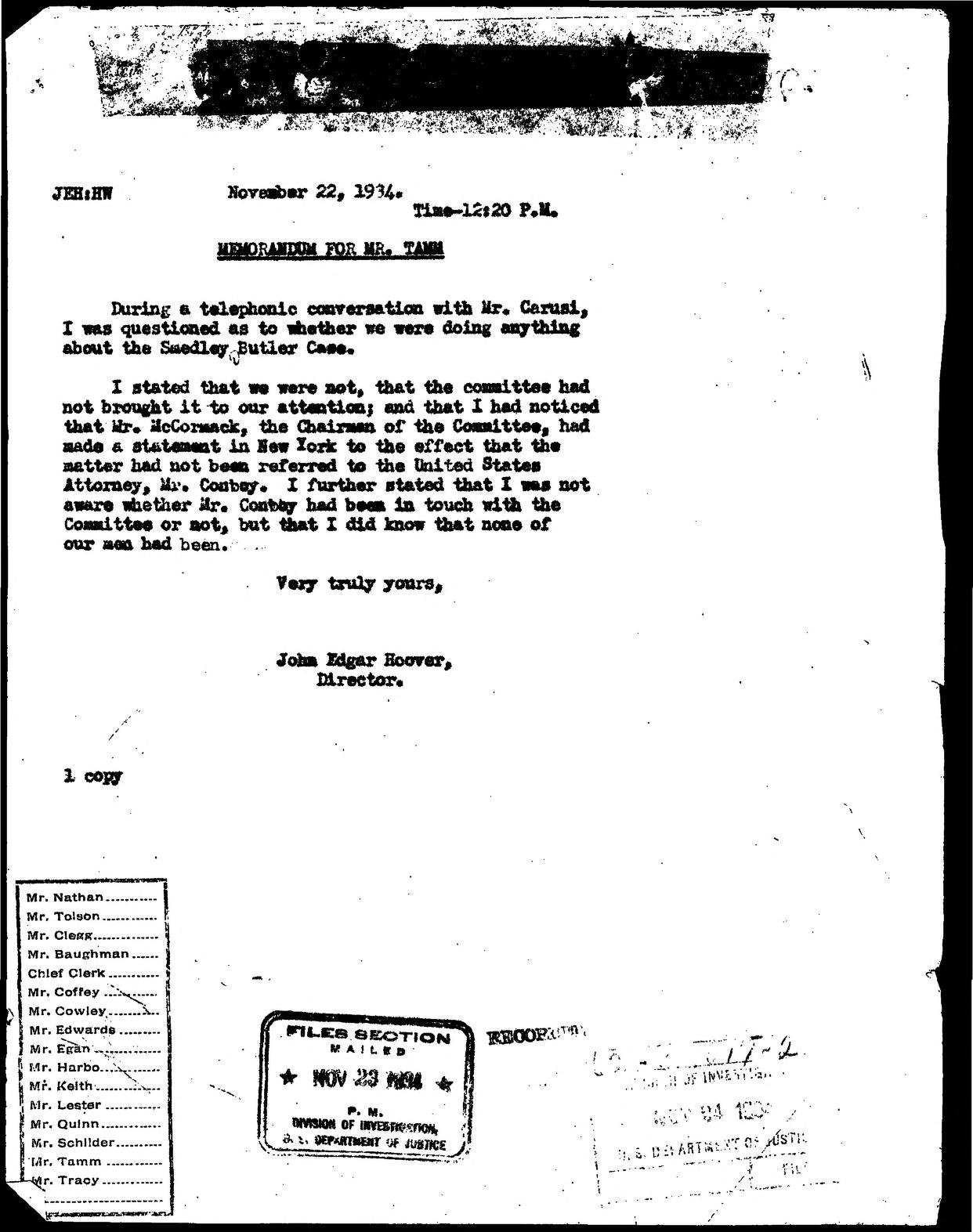
Image: FBI memorandum from Director J. Edgar Hoover to Assistant Director Edward A. Tamm regarding the Smedley Butler Case, November 22, 1934 — FBI Files, public domain via Internet Archive.