

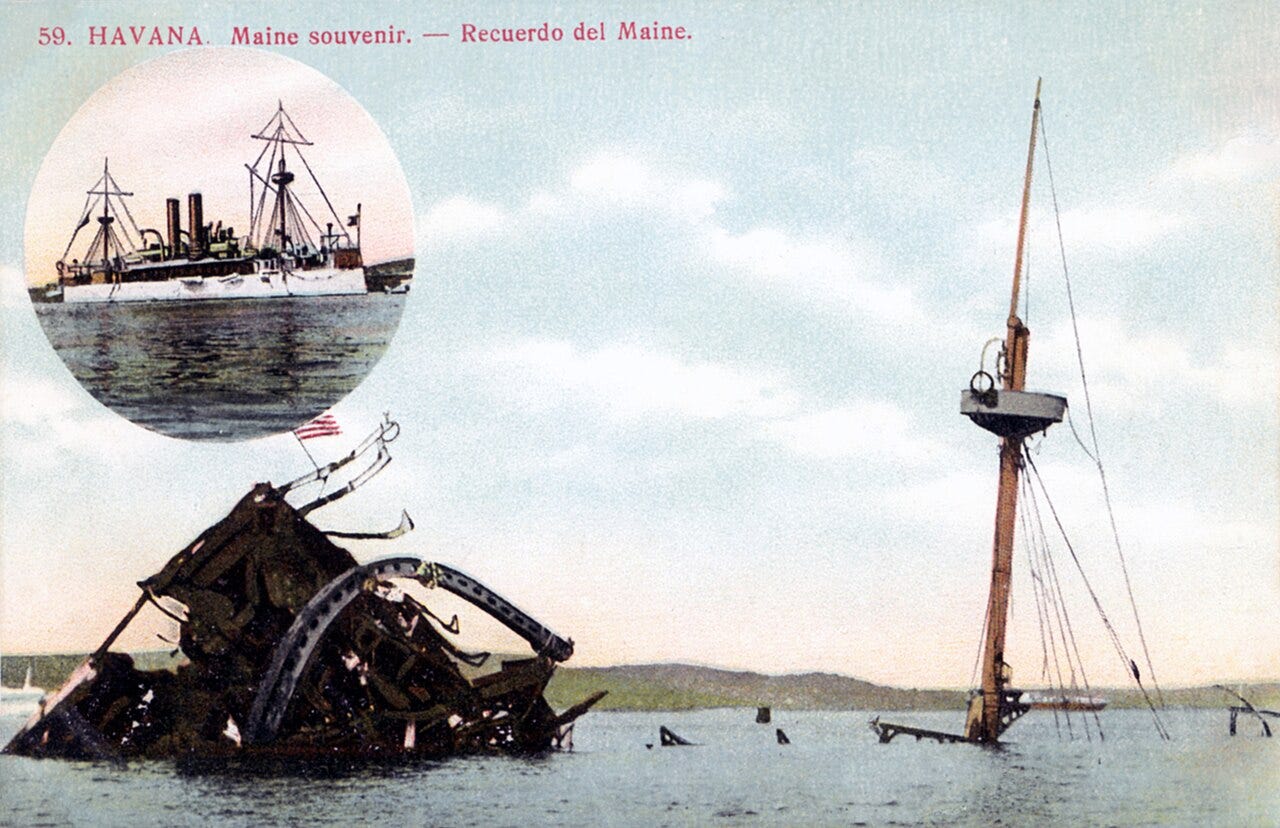
On the evening of February 15, 1898, the USS Maine exploded in Havana harbor. Two hundred and sixty American sailors were killed.
The American press knew, within forty-eight hours, what story it wanted to tell. William Randolph Hearst’s New York Journal and Joseph Pulitzer’s New York World were locked in a circulation war. Both papers ran the explosion as Spanish treachery. Hearst’s paper printed maps of how Spanish mines could have been placed. Neither paper had evidence. Both papers had headlines.
The cry Remember the Maine moved by rail and telegraph across the country. Within ten weeks, Congress had declared war on Spain. The Spanish-American War was fought, won, and finished in four months. The United States emerged with Cuba (under occupation), Puerto Rico, Guam, and the Philippines (acquired by treaty for twenty million dollars). Hearst’s Journal circulation crossed one million.
In 1976, a Navy investigation led by Admiral Hyman Rickover concluded that the most probable cause of the Maine explosion was an internal coal-bunker fire that detonated an adjacent ammunition magazine. Not Spanish mines. Not sabotage. A maintenance failure.
By 1976, the war was seventy-eight years past. The territories had been kept, lost, decolonized, and re-entangled. The newspaper headlines that had moved the country to war had not run a correction.
This is what a manufactured war looks like in retrospect. It looks like a maintenance failure with a headline.
What manufactured wars cost, and what they pay for, is one of the structural threads Peace Racket, Volume I traces from the Maine to Curveball. On Kindle.
Image: USS Maine wreckage with inset of the ship intact — Detroit Publishing Co. postcard, c. 1898 — public domain via Wikimedia Commons.