


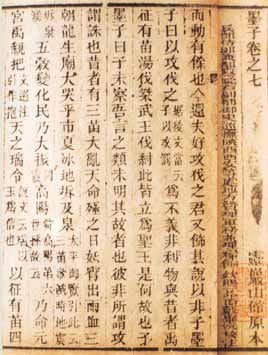
Image: Page from volume 7 (卷之七) of the Mozi (墨子), the Mohist canon containing the Fei Gong (非攻 — Against Offensive Warfare*) essays composed c. 5th–4th century BCE during the Warring States period of ancient China. The visible text discusses ancient sage-kings and the moral distinction between justified expedition and offensive war. Traditional Chinese woodblock-printed edition. Image via Wikipedia user Iflwlou; underlying text and printed edition in the public domain. Source: Mozi (Wikipedia).
To kill one man is to be called a criminal. To kill ten thousand is to be called a great general.
Mozi was a Chinese philosopher who lived from approximately 470 to 391 BCE, in the period the Chinese historical tradition calls the Warring States. The states were warring. He named what he saw.
His school, the Mohists, produced one of the earliest organized pacifist traditions in human philosophy. The core ethical concept was jian’ai — usually translated as impartial care or universal love — the proposition that one should care for the welfare of strangers with the same intensity one cares for the welfare of one’s own family. The political-economy consequence Mozi drew from jian’ai was straightforward: aggressive warfare is wrong because it treats the welfare of distant strangers as worth less than the political ambition of one’s own ruler.
The Mohist canon includes three essays under the heading Fei Gong — Against Offensive Warfare — that lay out the argument structurally. Mozi observes that a thief who steals one pig is condemned; a state that destroys ten thousand lives is celebrated. The arithmetic is the same. The labels differ because the scale differs. The scale should not change the moral judgment.
The Mohist school was suppressed during the Qin and Han dynasties. The texts survived. The argument is still standing.
Mozi’s arguments, and the line of witness that runs forward from him, are traced in Peace Racket, Volume I. Available in paperback, hardcover, and Kindle. Volume II is being written.