

Two hundred and fifty years tomorrow.
The Declaration was signed in Philadelphia on July 4, 1776. The Republic those signatures inaugurated has held — through revolution and reconstruction, civil war and depression, world wars and the long cold war that followed, the apparatus the postwar decades built, and the wars the apparatus has called for. The Republic held. Two and a half centuries of holding.
Tomorrow we observe the holding. Today we sit on the eve.
Eisenhower’s pencil note belongs to today.
Now — on Friday noon I am to become a private citizen of the U.S. I am proud to do so. Thank you — and Goodnight.
— Dwight D. Eisenhower, handwritten note, Page 26 of the Farewell Address reading copy
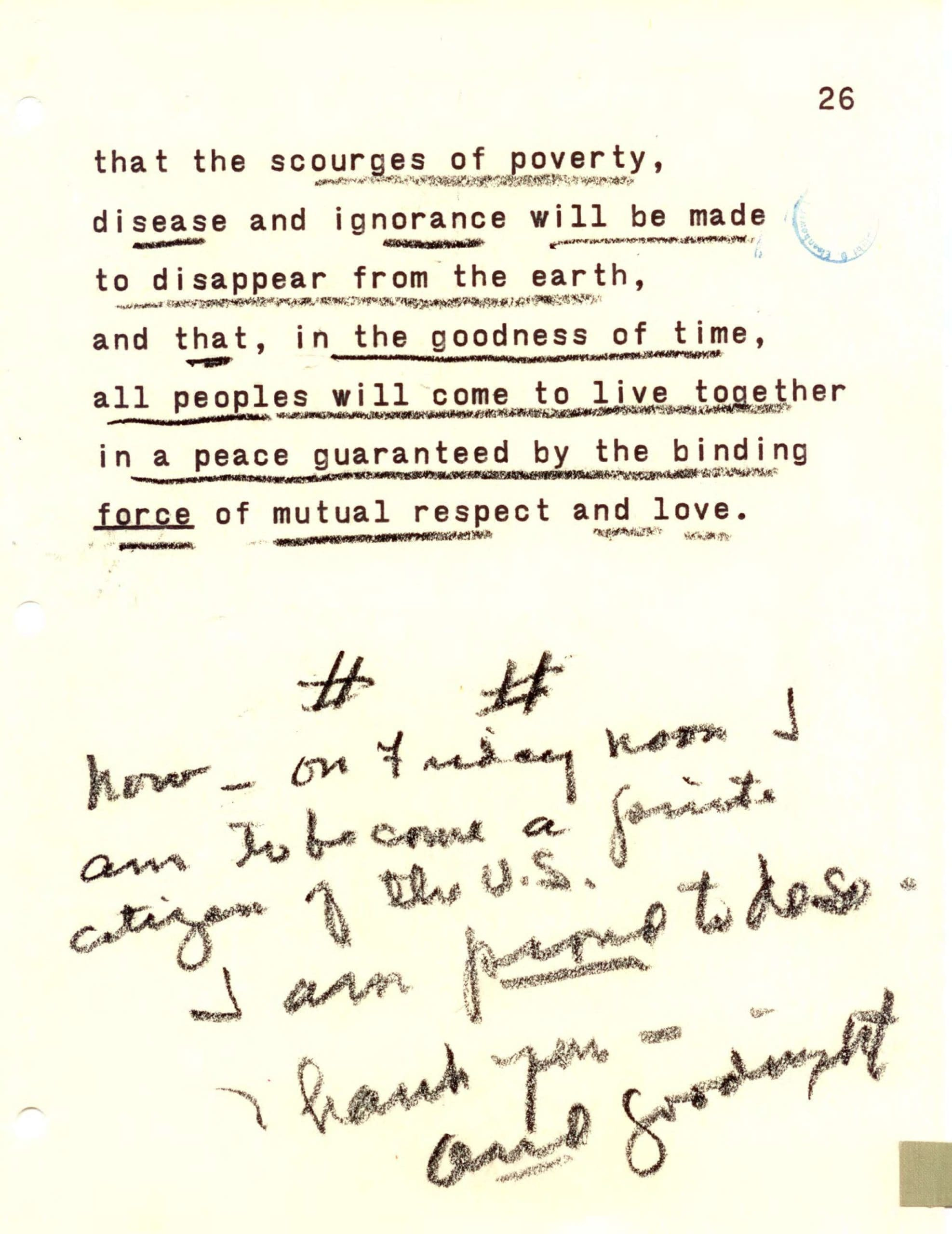
Image: Page 26 of President Dwight D. Eisenhower's reading copy of his Farewell Address (January 17, 1961), with Eisenhower's handwritten note at the bottom looking ahead to Friday noon — January 20, 1961 — when he would step into private citizenship. Eisenhower Presidential Library / National Archives; public domain. Source: DocsTeach.org.
Eisenhower wrote those words in pencil at the bottom of the last page he had just finished reading from the Oval Office. The address had been delivered the evening of Tuesday, January 17, 1961. The next morning would be Wednesday. Thursday would be inauguration eve. And on Friday at noon, he would step out of the office he had held for eight years and into the private citizenship he had described in plain pencil at the bottom of the page.
Five-star general. Supreme Allied Commander, Europe. President of the United States. None of those titles was the last title Eisenhower wrote down. The last title he wrote down was private citizen of the U.S. And he said he was proud of it.
He had been the inside witness from the soldier-statesman tradition. He had built the apparatus he warned against on January 17. He had presided over it for one term. And then he wrote, at the bottom of the last page, that he was proud to become a private citizen — because the citizenship is the form the Republic actually takes in the country between elections, the country between speeches, the country between the moments the political class assembles for the public ceremony.
The country is not the speech. The country is what the country does after the speech.
Eisenhower knew this. The Farewell ended on the prayer at the bottom of Page 26 — that the scourges of poverty, disease and ignorance will be made to disappear from the earth, and that, in the goodness of time, all peoples will come to live together in a peace guaranteed by the binding force of mutual respect and love. The prayer was delivered in plain presidential prose. The handwritten note underneath was the man stepping back into the citizenship the prayer required.
The Republic’s next two hundred and fifty years will be held by whoever holds them.
Not by the political class alone, who will continue what political classes always continue. Not by the apparatus, which will continue what apparatuses always continue. Not by the institutional architecture, which holds what its architecture holds and no more. The next two hundred and fifty years will be held by the alert and knowledgeable citizenry Eisenhower’s speech named earlier that evening, by the bodies that show up where bodies are needed, by the voices that say what voices are required to say, by the work that gets done because somebody decided it was theirs to do.
Each of us has been given a particular set of tools. Not the same tools. The tools we were given. The work we were given them for. It matters not whether we approach from the Holy or the Secular; the song remains the same.
You don’t have to be Eisenhower. You don’t have to be Bates or King or Marshall or Rankin or Butler or Burns or Newton or Smith or Douglass or any other figure the Peace Racket line of witness has tracked. You don’t have to have built the apparatus, presided over the country, marched up Pennsylvania Avenue, written a hymn, delivered a farewell, written a pamphlet that named the racket, or done any of the public-square things the line of witness has done at its joints.
You have to do the work you were given, in the register you were given it in, with the tools you were given to do it with.
That’s all. That’s enough. That’s the whole thing.
Tomorrow the country observes two hundred and fifty years.
The Republic the signatures inaugurated is the Republic the citizens hold.
The next paragraph the line of witness writes is the paragraph you write.
It’s your turn now.
Peace Racket, Volume I is available in paperback, hardcover, and Kindle. Volume II is on Kindle. The line of witness this project tracks runs from Adam Smith in 1759 to Martin Luther King Jr. in 1968. The next joint of the spine is you.