

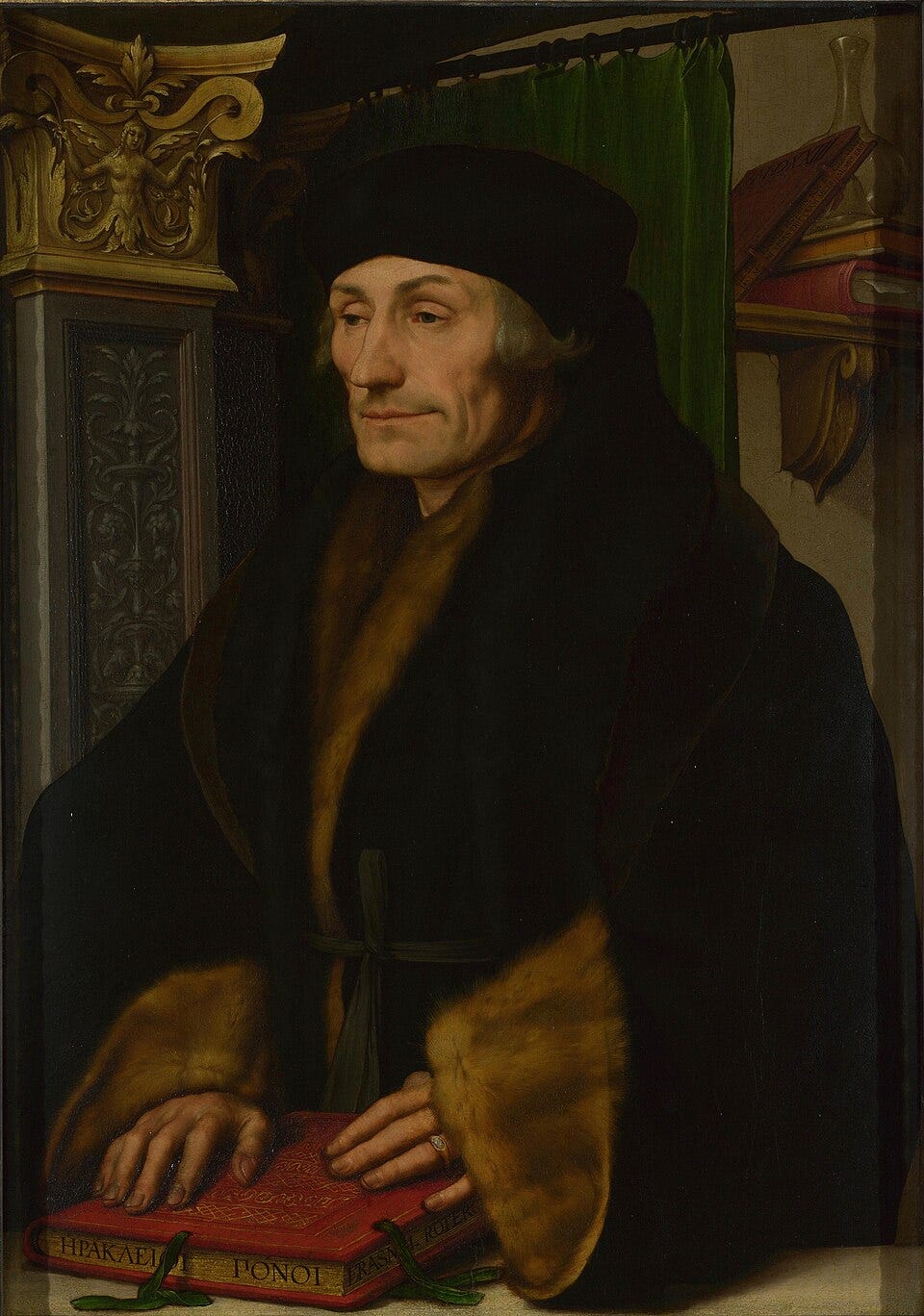
Image: Hans Holbein the Younger, Portrait of Erasmus of Rotterdam, oil on panel, 1523. National Gallery, London (on long-term loan from Longford Castle, the Earl of Radnor collection). Public domain by age. Available via Wikimedia Commons.
_-_Erasmus_-_National_Gallery.jpg)
Dulce bellum inexpertis. War is sweet to those who have not tried it.
— Erasmus of Rotterdam, Adages (1515), III.iii.1
In December 1517, a small book was printed in Basel by Johann Froben. It was written in Latin. It was seventy-odd pages long. Its title was Querela Pacis undique gentium eiectae profligataeque — The Complaint of Peace, Driven from All Nations and Suppressed. Its author was Desiderius Erasmus of Rotterdam, at that moment the most famous scholar in Europe.
The book did something no European book had quite done before.
It gave Peace a voice.
The device is simple and startling. Peace is not the subject of the essay. Peace is not being explained. Peace is the speaker. She enters the text as a person, in the first-person feminine, and begins to describe her own exile. She has been driven from the courts of princes, from the councils of clergy, from the halls of universities, from the sanctuaries of monasteries, from the marriage beds of Christians, from the very churches that carry her name in their liturgy. She wanders. She finds no home.
In paraphrase-condensation of the opening pages: I, Peace, once counted among the highest goods, now find no place to rest. Those who cry my name in prayer drive me out in practice. Those who preach me on Sunday commission the arms on Monday. If I were being expelled for your welfare, I could bear the exile. But I am driven out to your ruin as much as mine.
She names, over the course of the little book, the specific machinery of her expulsion: princely ambition disguised as national interest; clerical faction disguised as theology; scholarly rivalry disguised as truth; the merchant’s calculation that a modest war profitable to a few is preferable to a lasting peace profitable to all.
The argument is not that peace is fragile. The argument is that peace is actively expelled by those who would benefit from her absence. The apparatus of war is producing what Erasmus, five hundred and nine years ago, already recognized as the racket.
Erasmus was not naive.
He wrote Querela Pacis between two catastrophic phases of European war. The Italian Wars had raged intermittently from 1494 to 1516, killing perhaps a million people across the peninsula. The Wars of Religion — the Schmalkalden, the French Wars of Religion, the Thirty Years’ War — were about to begin. Erasmus could see, with a scholar’s clarity, that the pause was temporary.
He had written Dulce bellum inexpertis — War is Sweet to Those Who Have Not Tried It — as an entry in his Adages in 1515, arguing that the horror of war is invisible to the young and to the councilors who have never seen it. He had written Institutio principis christiani — The Education of a Christian Prince — in 1516, addressed to the young Charles V, arguing that a Christian ruler’s first obligation is to preserve his people from the machinery of war. He had corresponded with Thomas More, whose Utopia appeared the same year, on the same theme. Querela Pacis was the completion of the argument. Peace, having been argued for as policy and taught as princely duty, was finally given her own voice to speak.
Six weeks before Querela Pacis was printed in Basel, on October 31, 1517, an Augustinian friar named Martin Luther posted ninety-five theses on the door of the Castle Church in Wittenberg. Erasmus and his printer did not yet know what those theses would mean. But within a decade, Erasmus’s dream of a unified Christian Europe capable of choosing peace over war would be structurally impossible. The apparatus that produced the Wars of Religion was already assembling itself while his little book about peace was being bound.
The literary device survived its historical moment.
Peace as speaker is a move the line of witness continues to make.
Butler in 1935 named the racket by naming what the apparatus produces on the far end — corpses and profits and ruined polities. Erasmus in 1517 named the racket by giving Peace a voice with which she could describe her own exile. Same insight. Different rhetorical register. Both witnesses looking at the same medium and asking, why do those who cry my name drive me out?
The humanist variant of the line of witness is Erasmus. He is not a chapter in Volume II — the volume follows a different set of witnesses forward — but he stands as the literary grandfather of the whole tradition. Any project that names peace as a person to be honored rather than a condition to be preserved is a project descended from the small book Froben printed in Basel in December 1517.
The book is available. Multiple modern English translations of Querela Pacis remain in print. It is short. It can be read in one long evening.
Peace still speaks, present tense, when someone opens the book. She still describes her exile. She still asks the question about the distance between what is prayed and what is procured.
Any evening is a good evening to sit with her.
The humanist tradition of peace-witness is the philosophical grandfather of the line the volume the newsletter accompanies is tracking. Peace Racket, Volume I — available in paperback, hardcover, and Kindle — carries the argument forward. Peace Racket, Volume II is being written now. Peace still speaks. The next paragraph is the one you write.