

On the evening of January 17, 1961, three days before John F. Kennedy was sworn in as the next president, Dwight Eisenhower addressed the country from the Oval Office.
He had served thirty-seven years in the Army before two terms in the White House. He had commanded Operation Overlord on June 6, 1944 — the largest amphibious assault of the Second World War, and the operation that effectively turned the European war. He had been Supreme Commander, Allied Expeditionary Force. He had come home, served as Army Chief of Staff, become president of Columbia University, returned to active duty as the first Supreme Commander of NATO, and run for president in 1952.
He knew the apparatus from the inside.
The Farewell Address was the second strike. The first had been Marshall — Eisenhower’s mentor, who had built the postwar military Eisenhower inherited, and who had been awarded the Nobel Peace Prize for the Plan named after him. Eisenhower took the Marshall position and addressed it forward.
The phrase he used was the military-industrial complex. The structural warning was clean: In the councils of government, we must guard against the acquisition of unwarranted influence, whether sought or unsought, by the military-industrial complex. The potential for the disastrous rise of misplaced power exists and will persist.
He coined the phrase. He named the structural mechanism. He spoke as the soldier-president whose standing alone could deliver it.
Sixty-five years later, the apparatus he warned against has grown to a scale he could not have imagined in 1961.
Eisenhower’s full Farewell Address — and what has happened in the sixty-five years since — runs through Peace Racket, Volume I. In paperback, hardcover and Kindle.
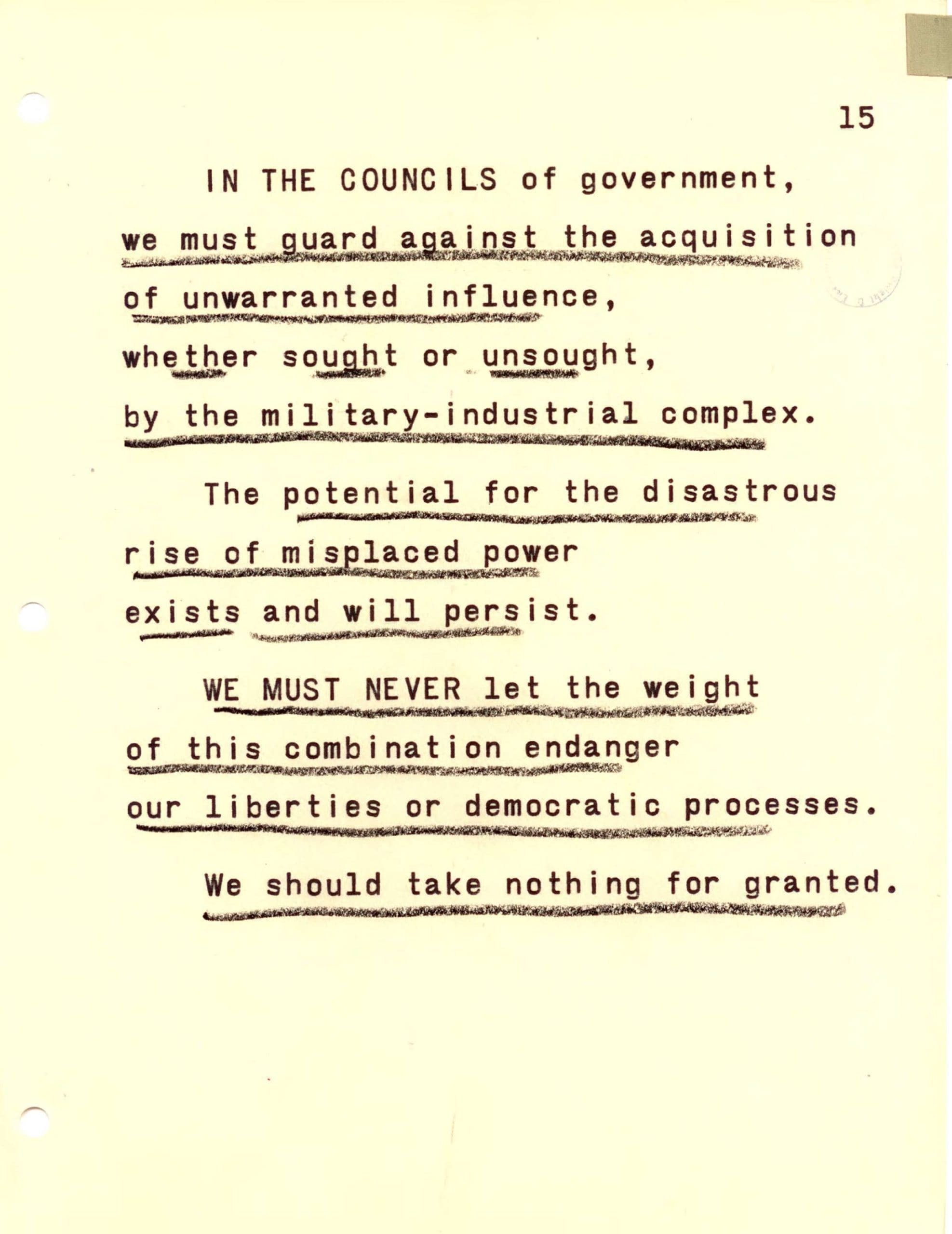
Image: Page 15 of President Dwight D. Eisenhower's reading copy of his Farewell Address, delivered from the Oval Office on the evening of January 17, 1961. Eisenhower's own crayon underlining marks the warning against the "military-industrial complex" and the closing instruction, "We should take nothing for granted." Eisenhower Presidential Library / National Archives; public domain. Source: DocsTeach.org.