


Edward Bernays was Sigmund Freud’s nephew. He was born in Vienna in 1891, grew up in New York, served on the Wilson administration’s Committee on Public Information during the First World War, and then went into private practice as the inventor of what he called public relations.
In 1928 he published Propaganda. It was not a critique. It was a manual.
The conscious and intelligent manipulation of the organized habits and opinions of the masses is an important element in democratic society, he wrote on the first page. Those who manipulate this unseen mechanism of society constitute an invisible government which is the true ruling power of our country.
He meant it as a description of the business he was in. He also meant it as an endorsement.
His most famous early campaign was in 1929 for the American Tobacco Company. Cigarettes were socially unacceptable for women in public. Bernays staged a contingent of debutantes to march in New York’s Easter Sunday Parade, lighting Lucky Strikes at a coordinated moment, with photographers prepositioned. He called them Torches of Freedom and pitched the act to the press as women’s-suffrage symbolism. The press ran it. Cigarette sales to women rose substantially in the years that followed.
He coined the phrase the engineering of consent in a 1947 paper of that name and expanded the argument in 1955.
He died in 1995 at age 103, having given his name to the modern profession he created.
Bernays’ manual is one of the foundational documents Peace Racket, Volume I engages with directly. In paperback, hardcover and Kindle.
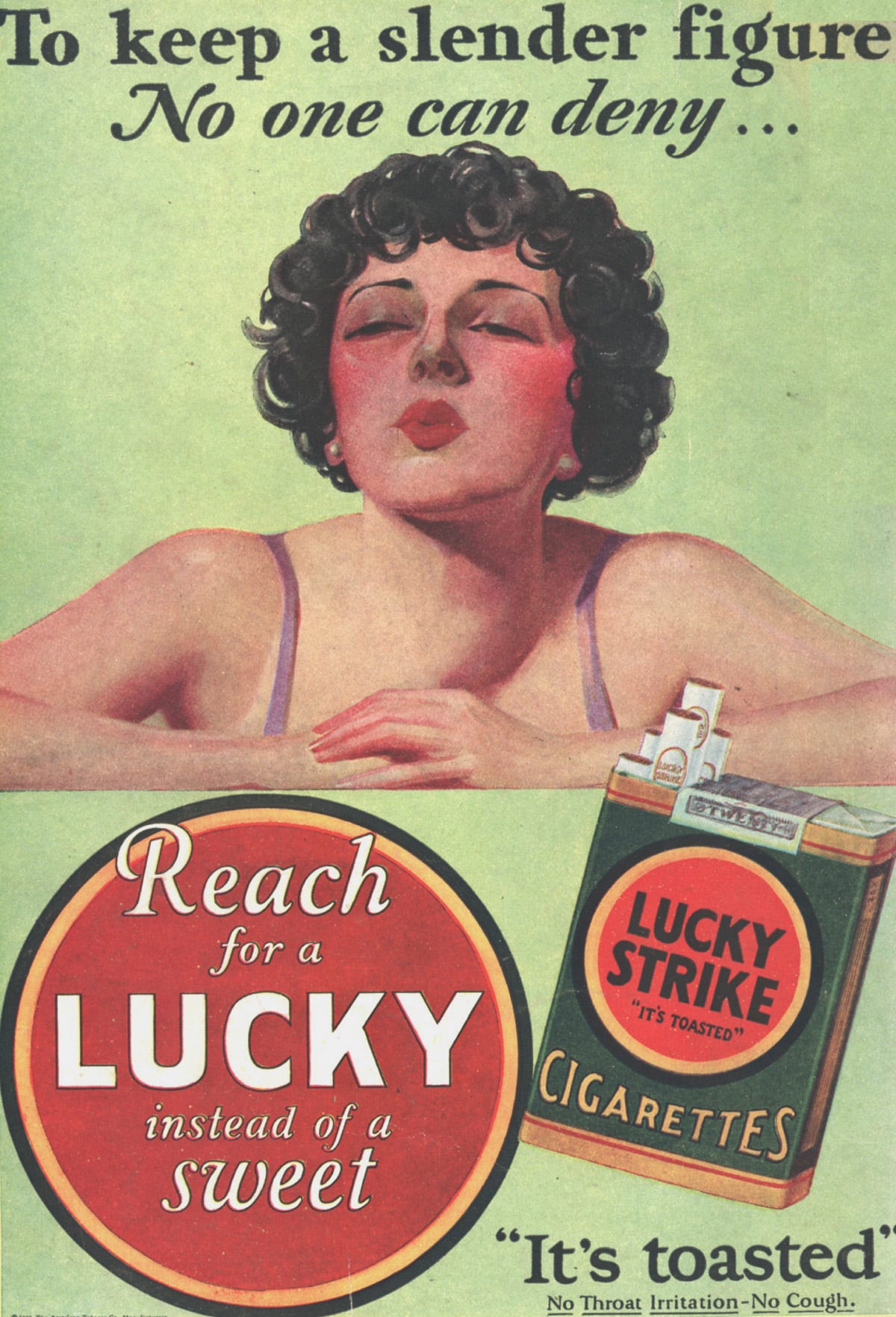
Image: Lucky Strike advertisement from American Tobacco's "Reach for a Lucky instead of a sweet" campaign (c. 1929) — the signature campaign Edward Bernays designed for American Tobacco after his 1928 hire by George Washington Hill, manufacturing the cultural link between cigarettes and a slender figure to expand the brand's market to women. The "It's toasted" subhead was a pre-existing American Tobacco slogan dating to 1917; the slender-figure positioning was Bernays's addition. Public domain via Stanford Research into the Impact of Tobacco Advertising (tobacco.stanford.edu).