

Johan Galtung distinguished between negative peace, the absence of direct violence, and positive peace, the presence of conditions that make violence unnecessary.
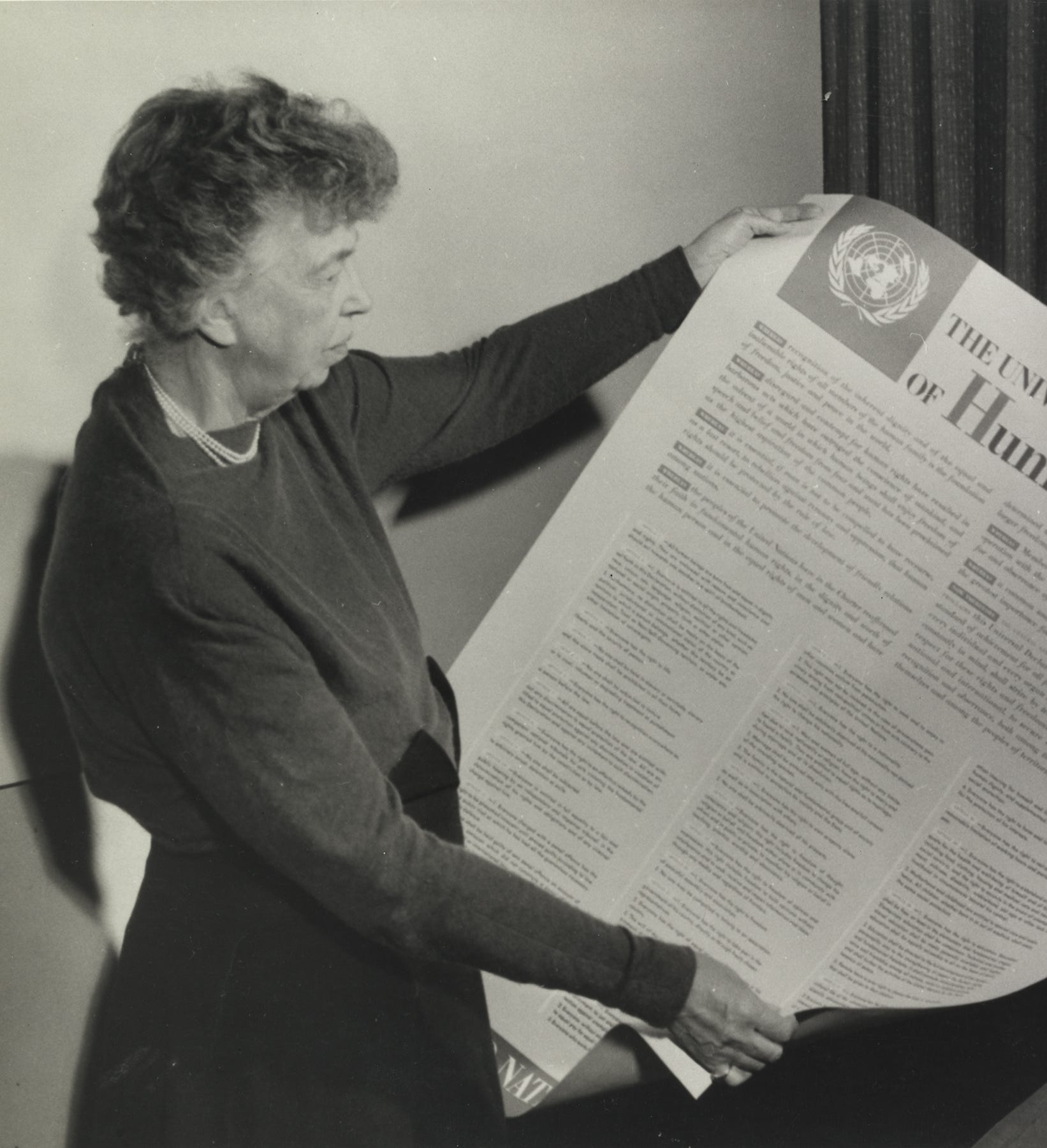
Eleanor Roosevelt holding a printed broadside of the Universal Declaration of Human Rights, approximately 1949. Mrs. Roosevelt chaired the UN Commission on Human Rights that drafted the UDHR, adopted by the UN General Assembly on December 10, 1948 — one of the principal pieces of post-1945 positive-peace construction the missive names. Photograph via the Franklin D. Roosevelt Presidential Library Press Kit; public domain.
Johan Galtung published Violence, Peace, and Peace Research in 1969. He was a Norwegian sociologist. He gave us the distinction we have been working with ever since.
Negative peace is the absence of direct violence. The guns are silent. The bombs are not falling. This is a real and important achievement. A ceasefire is a real and important achievement. The interval between active wars is a real and important achievement.
But negative peace is not stable. It is not the underlying condition; it is the temporary surface condition. The same structural pressures that produced the last war remain in place. They will produce the next one, on the same schedule the pressures permit.
Positive peace is the structural condition in which the pressures that produce war are themselves dismantled. Galtung named the elements: equity, justice, functioning institutions, ecological balance, the absence of what he called structural violence — the slow, systemic harm that institutions can inflict on the populations they nominally serve.
Negative peace is the floor. Positive peace is the building.
The American post-1945 order constructed portions of the building. The United Nations Charter, 1945. Bretton Woods, 1944. The Marshall Plan, 1948. The Universal Declaration of Human Rights, 1948. NATO, 1949. Smallpox eradication, declared complete 1980. The Internet. These were not accidents; they were construction work of positive peace at a particular historical moment, undertaken by people who had just watched a war kill seventy million people and had decided to build something else.
What follows the construction is the maintenance. The racket depends on the citizen mistaking the temporary floor for the building, and then forgetting that even the floor has to be kept clean.
Peace as a structural achievement, not a default state, is the argument Peace Racket, Volume I builds on. Available in paperback, hardcover, and Kindle. Volume II is on Kindle.