


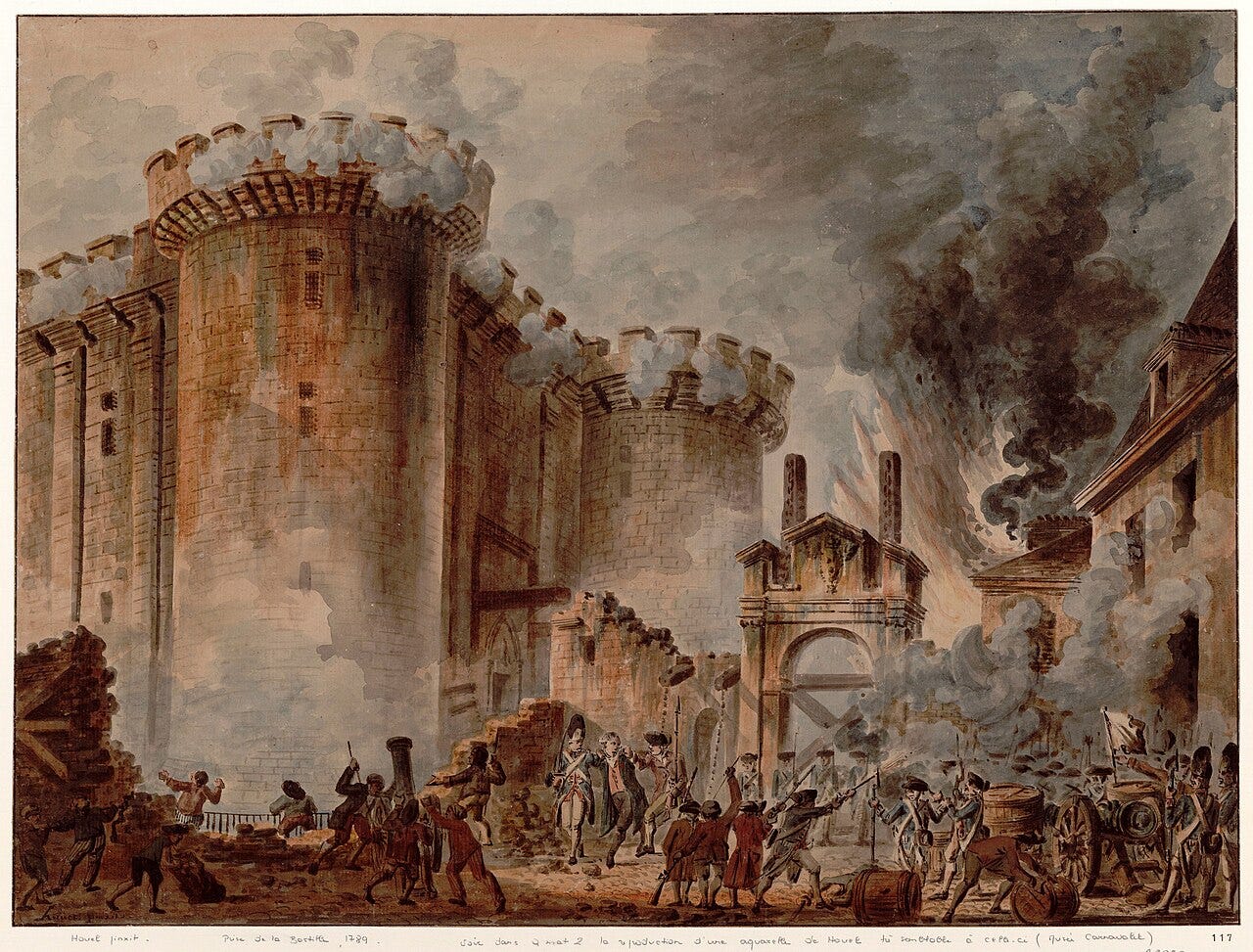
Image: Jean-Pierre Houël, Prise de la Bastille (Storming of the Bastille), watercolor, 1789. Original at the Musée Carnavalet, Paris. Digital reproduction via the Bibliothèque nationale de France (Gallica). Public domain by age. Available on Wikimedia Commons.

Men are born and remain free and equal in rights. Social distinctions may be founded only on the common good.
— Déclaration des droits de l’homme et du citoyen, Article 1 (August 26, 1789)
Today is the two hundred and thirty-seventh anniversary of the storming of the Bastille.
On July 14, 1789, a crowd estimated at one thousand Parisians surrounded the medieval fortress on the eastern edge of the city. The Bastille had been built in the 1370s as a defensive gate. By 1789 it had become a state prison, holding — on the day it was stormed — seven prisoners: four forgers, two men judged insane, and one aristocrat. The building itself mattered more than its inhabitants. It was the visible symbol of arbitrary royal authority: the lettre de cachet king could imprison any subject without trial, and the Bastille was where the imprisoned went.
The crowd had come first to demand gunpowder. They had marched from the Hôtel des Invalides earlier that morning, where they had seized muskets. What they needed to make the muskets useful was black powder, which was known to be stored at the Bastille. Negotiations with the fortress’s governor, the Marquis de Launay, broke down. A skirmish began. Reinforcements arrived on the crowd’s side. By late afternoon the fortress had fallen. De Launay was killed in the street. The heads of de Launay and the prévôt des marchands were paraded on pikes through the city.
That is the specific event.
The Bastille was demolished stone by stone in the months that followed. King Louis XVI recorded in his diary on July 14, 1789: “Rien.” — “Nothing.”
What the summer of 1789 was actually producing structurally was something the king did not yet see.
On June 17, 1789, the Third Estate — the commoners’ delegation to the Estates-General convened at Versailles to address the financial crisis — had declared itself the National Assembly. On June 20, locked out of their meeting hall, they had gathered on a nearby tennis court and sworn what became known as the Tennis Court Oath: not to disband until France had a written constitution. On July 9, they renamed themselves the National Constituent Assembly. On July 11, the king dismissed the finance minister Jacques Necker, who was widely trusted as a reformer. The dismissal was interpreted as a signal that royal forces were preparing to disperse the Assembly.
That is the context in which the crowd went looking for gunpowder on July 14.
Six weeks after the Bastille fell, on August 26, 1789, the National Constituent Assembly adopted the Déclaration des droits de l’homme et du citoyen — the Declaration of the Rights of Man and of the Citizen. Seventeen articles. Roughly nine hundred words in the original French. It affirmed liberty, property, security, resistance to oppression, equality before the law, freedom of speech, freedom of the press, presumption of innocence, and the sovereignty of the nation. It became one of the foundational documents of modern human-rights thought.
The Marquis de Lafayette — Gilbert du Motier — drafted an early version of the Declaration with Thomas Jefferson’s counsel in Paris. Lafayette had fought under Washington in the American Revolution. He had returned to France believing what he had helped defend in Massachusetts and Virginia might now be built at home. On the morning of July 15, 1789, the day after the Bastille fell, Lafayette was named commander of the newly formed National Guard.
Two revolutions. One life.
The honest counter-record.
The same revolution that produced the Declaration also produced, four years later, the Reign of Terror. From approximately September 1793 to July 1794, the Committee of Public Safety authorized the execution by guillotine of an estimated seventeen thousand people, with tens of thousands more killed in provincial repressions — most notoriously the drownings at Nantes and the mass shootings at Lyon.
The apparatus that had liberated the Bastille four years earlier had, through the sequence of ideological hardening, external war, internal factional purge, and revolutionary paranoia, produced a machinery of state killing that operated with the same efficiency it had once used against arbitrary royal authority.
Maximilien Robespierre — architect of the Committee of Public Safety, chief public defender of the Terror as necessary revolutionary virtue — was himself arrested on July 27, 1794 and executed on July 28. The apparatus consumed its own most dedicated custodian.
Lafayette, by then, was in an Austrian prison. He had fled France in August 1792 to avoid arrest by the Jacobins; his party was captured; he was held in captivity by the Austrians and Prussians for five years. He was freed in 1797 at Napoleon’s insistence. He returned to France. He lived through the Consulate, the Empire, the Bourbon Restoration, the July Revolution of 1830, and the Orleanist monarchy. He died on May 20, 1834, and was buried at the Picpus Cemetery in Paris.
American soil, brought to Paris in a small quantity, was scattered on his grave.
The American flag has flown continuously at Lafayette’s grave at Picpus Cemetery since his burial — through the Third Republic, both World Wars, the Nazi occupation, the Fifth Republic, and every French summer since. On July 4, 1917, the day American troops first paraded through Paris in the First World War, the American commander Charles Stanton stood at Lafayette’s grave and said, in the phrase attributed to him: Lafayette, we are here.
Peace is a working condition. Revolutions are not automatically its friend. A revolution can produce a Declaration of the Rights of Man and a Committee of Public Safety inside the same five-year window. What survives the revolution is what its successors continue to maintain.
The Declaration of 1789 continues, present tense, to be part of the French constitutional order. It is cited by French courts. It is taught in French schools. It is the founding structural document Lafayette went home to help write after helping build the country he first fought for.
Any day is a good day to sit with the Declaration.
Bastille Day is a particularly good one.
The line of witness the volume the newsletter accompanies is tracking runs from Adam Smith in 1759 forward. Lafayette is not a chapter, but he is the sort of witness the line collects: the man who fought at Yorktown and then drafted the Declaration of the Rights of Man with Jefferson’s counsel. Peace Racket, Volume I — available in paperback, hardcover, and Kindle — traces the argument. Peace Racket, Volume II is being written now. The next paragraph is the one you write.