


In 261 BCE the Mauryan emperor Ashoka completed his conquest of Kalinga, on the eastern coast of the Indian subcontinent. He won. The Mauryan state, already the largest political entity the subcontinent had ever produced, now reached from the Hindu Kush to the Bay of Bengal.
He walked the field after the battle. By his own subsequent account, carved into rock on what is now Edict XIII, one hundred thousand were killed and many times that number perished — combatants, civilians, prisoners, the deported populations who died on the way to exile.
He had his own account of his remorse carved into rocks and pillars across the empire.
The edicts are still readable. They are in Prakrit, in Brahmi script, occasionally in Greek and Aramaic at the empire’s western edges. They name the regret directly. They commit the rest of his reign to what he called Dhamma — a public ethic of restraint, religious tolerance, welfare for subjects and conquered peoples alike, and the deliberate refusal of further military conquest. He sent emissaries instead of armies to the Hellenistic kingdoms — Antiochus II, Ptolemy II, Antigonus Gonatas — proposing exchanges in philosophy and medicine.
The line of witness this project tracks begins, in its earliest named figure, with a king who walked his own battlefield and decided to stop.
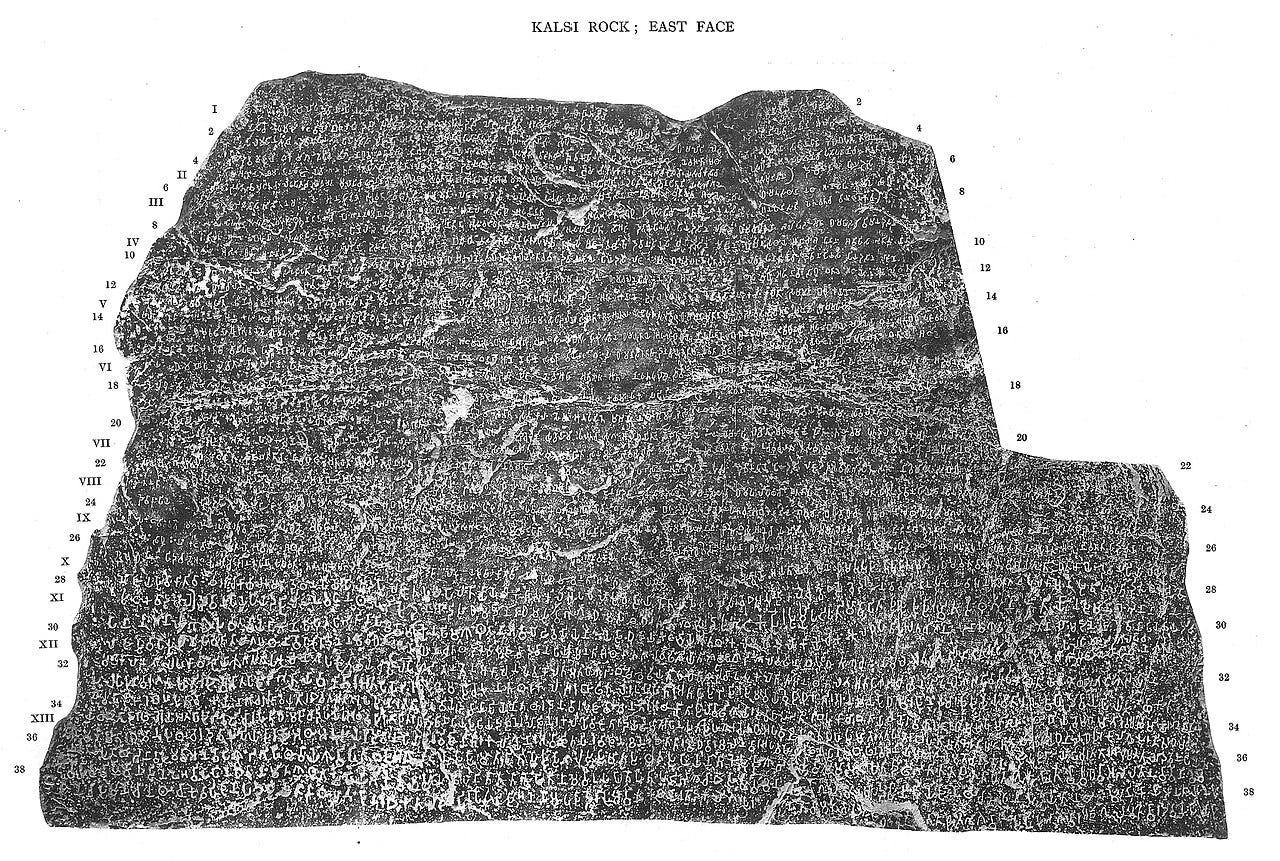
Image: The east face of the Kalsi rock in present-day Uttarakhand, India, bearing all fourteen of Ashoka’s Major Rock Edicts inscribed in Brahmi script c. 261–232 BCE. Roman numerals at left mark each edict; Major Rock Edict XIII — the Kalinga War remorse text — begins at the bottom. Photographic plate from E. Hultzsch, Inscriptions of Asoka (Corpus Inscriptionum Indicarum Vol. I, Oxford: Clarendon Press, 1925); public domain via Wikimedia Commons.

Ashoka’s full transformation — and the line of witness that runs forward from him — is traced in Peace Racket, Volume I, in paperback, hardcover and Kindle.